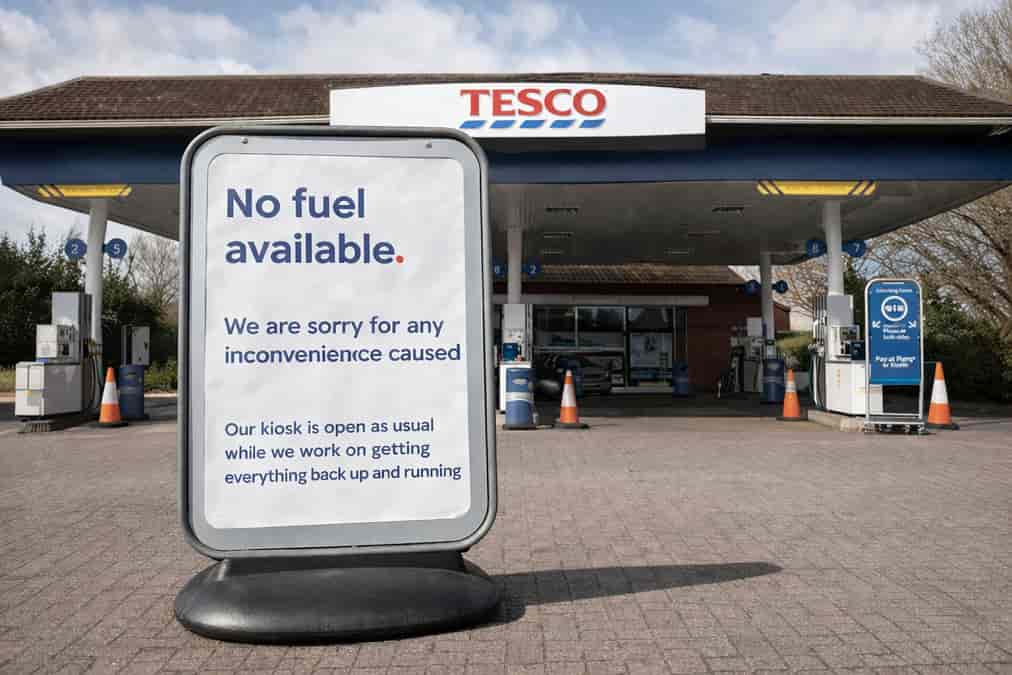
Workers heading into their jobs this morning were met with an unexpected disruption that speaks to a much bigger global issue. At a Tesco Superstore in Worcester, motorists found themselves unable to fill up, with pumps closed and a stark message: no fuel available.
For many, this was more than an inconvenience. It is the early, visible ripple of a wider geopolitical shock now filtering directly into the daily routines and finances of UK workers.
What has happened?
The immediate cause lies far beyond Worcester. Escalating tensions linked to conflict involving Iran have disrupted key oil shipping routes, particularly through the Strait of Hormuz — one of the most critical arteries for global energy supply.
As tankers face restrictions and delays, the price of Brent crude has surged dramatically, rising from around $73 per barrel to over $100 in a short period. This is not just a number on a trading screen — it directly translates into higher fuel costs at UK forecourts.
Rising prices and real impact
According to industry analysis, every $10 increase in oil prices can add approximately 7p per litre at the pumps. Data linked to the RAC Foundation shows petrol prices have already climbed by 16.6p per litre to 149.44p, while diesel has surged even more sharply, rising by 33.4p to 175.73p.
Steve Gooding has warned that the financial consequences are unavoidable for workers and businesses alike. His message is clear: whether commuting, running a household, or operating a business, fuel costs are a fundamental part of everyday spending — and they are rising fast.
For UK workers, the implications are immediate and personal:
- Increased commuting costs
- Pressure on already stretched household budgets
- Higher prices for goods and services as businesses pass on costs
Even those who do not drive will feel the impact, as transport costs feed into the wider cost of living.
Supply concerns: how serious is it?
The UK Government has sought to reassure the public, stating that fuel supply remains “resilient.” The Department for Energy Security and Net Zero has confirmed that the UK maintains strong reserves and diversified supply lines.
As a member of the International Energy Agency, the UK is required to hold at least 90 days’ worth of net oil imports — and reportedly exceeds this threshold.
Crucially, most UK oil imports come from stable partners such as the United States and Norway, meaning the majority of national supply is not directly disrupted.
However, while supply may be secure at a national level, localised shortages — such as the one seen in Worcester — can still occur due to distribution pressures, panic buying, or logistical delays.
The worker reality
This is where the story matters most for The Workers Union and its members.
Fuel demand is what economists describe as “inelastic” — meaning people cannot easily reduce consumption in the short term. Workers still need to get to their jobs. Families still need to travel. Deliveries still need to be made.
In simple terms, workers do not have the luxury of avoiding these rising costs.
This creates a familiar but troubling pattern:
- Rising fuel prices
- Increased commuting costs
- Reduced disposable income
- Greater financial strain across households
For many, this comes at a time when budgets are already under pressure from inflation and broader economic uncertainty.
A wider cost-of-living concern
What began as a geopolitical conflict is now feeding directly into the UK’s ongoing cost-of-living challenge.
Businesses facing higher fuel costs may raise prices. Supply chains become more expensive. Everyday essentials — from food to services — can follow suit.
For workers, this is not just about petrol and diesel. It is about the cumulative effect of rising costs across all aspects of daily life.
What workers should watch next
The coming weeks will be critical. Key indicators to monitor include:
- Continued movements in oil prices
- Fuel prices
- Stability of UK fuel supply chains
- Any further local shortages or disruptions
- Government response or intervention measures
At present, experts warn that prices could rise further if global tensions escalate or shipping routes remain restricted.
The Workers Union perspective
At The Workers Union, the focus remains firmly on the lived experience of UK workers. Situations like this highlight how quickly global events can impact everyday working life — from getting to work, to managing household finances.
Ensuring workers are informed, prepared, and supported through these shifts is more important than ever.