
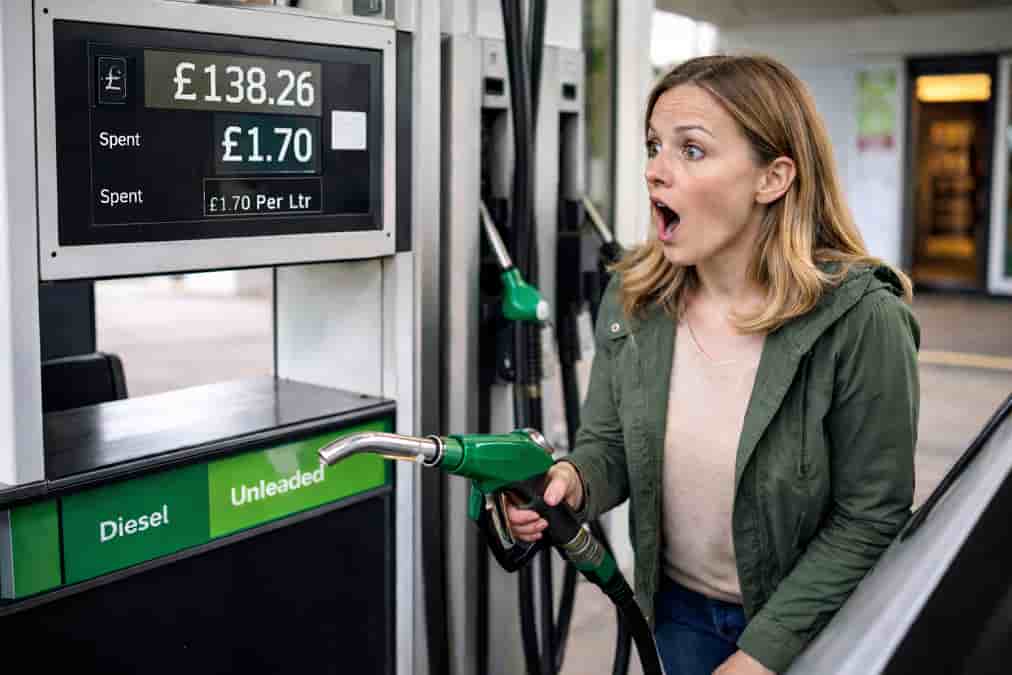
For millions of commuters travelling to work each day, the rising cost of petrol and diesel is quickly becoming another pressure on household budgets already stretched by living costs.
Latest figures show petrol and diesel prices have surged to their highest levels in more than 20 months. Since late February, drivers have seen pump prices increase by between 6.12p and 12.74p per litre, marking the sharpest jump since the early stages of the Ukraine conflict in 2022. UK workers who rely on their cars to get to work are facing a new financial squeeze as fuel prices surge sharply following escalating conflict in the Middle East.
At present, the average price sits at 138.96p per litre for unleaded petrol and 155.12p per litre for diesel. For many UK workers commuting daily, the impact is immediate. Filling a 55-litre diesel family car now costs around £6.67 more than it did just over a week ago, with further increases expected if global tensions continue.
Global tensions pushing fuel prices higher
The spike in fuel costs is closely linked to global oil markets. Brent crude oil, the key international benchmark, surged past $100 a barrel earlier this week, its highest level since 2022. Prior to the latest conflict escalation, oil had been trading closer to $73 per barrel.
The increase followed US and Israeli air strikes on Iran, which were followed by retaliatory attacks across several locations in the Middle East including the United Arab Emirates, Qatar, Bahrain, Jordan and Iraq. With the situation continuing to unfold, global markets remain highly sensitive to developments in the region.
One of the biggest concerns centres on the Strait of Hormuz, a vital shipping route through which roughly 20% of the world’s oil and gas supply passes. Iran has warned that vessels attempting to travel through the waterway could face attacks if the conflict deepens, creating fears of severe disruption to global energy supply.
For UK motorists and commuters, this geopolitical risk translates quickly into rising prices at the pump.
What this means for working people travelling to work
For many workers across the UK, driving is not optional. From healthcare staff and construction workers to retail employees and logistics drivers, millions depend on their cars to reach workplaces that may be poorly served by public transport.
In rural areas especially, commuting by car remains the only realistic option.
However, the financial impact is being felt quickly. Workers commuting long distances could see monthly travel costs rise significantly if petrol and diesel prices continue climbing towards projected levels.
Analysis from the Energy and Climate Intelligence Unit suggests that when oil trades around $100 per barrel, petrol prices typically approach 150p per litre. If oil rises further towards $120 per barrel, petrol prices could potentially reach 170p per litre, adding substantial costs for drivers.
Calls for caution as prices continue rising
Industry figures say motorists should expect further increases in the coming weeks.
AA president Edmund King has warned that the longer tensions continue in the Middle East, the greater the impact on fuel prices. He has advised drivers not to panic but to consider reducing unnecessary travel where possible.
At the same time, RAC head of policy Simon Williams says the current trend suggests petrol could soon exceed 140p per litre, while diesel may rise to 160p per litre or more.
Both organisations have urged drivers to continue refuelling as normal but to compare prices between fuel stations to find the best deals.
Could UK workers see mileage reimbursement increases?
One key question now emerging among commuters is whether employers or the Government may review mileage allowances to reflect rising fuel costs.
Many UK workers who use their own vehicles for work-related travel rely on the Approved Mileage Allowance Payments (AMAP) system. Currently, the rate commonly used for tax-free reimbursement remains 45p per mile for the first 10,000 miles, and 25p per mile thereafter.
However, this rate has remained unchanged for years despite fluctuating fuel prices.
If pump prices continue climbing, pressure may grow for a reassessment of mileage allowances to better reflect real-world travel costs faced by workers using their own vehicles for work.
Government response to rising pump prices
The Chancellor, Rachel Reeves, has already warned that the Government will not tolerate excessive pricing at fuel forecourts. Some petrol stations have reportedly charged as much as 180p per litre, prompting concerns about potential price exploitation.
Reeves is expected to meet fuel retailers to discuss the situation and ensure pricing remains fair for consumers.
At the same time, pressure is building over the Government’s planned fuel duty increase, which would reverse the temporary 5p per litre cut introduced in 2022. Some analysts argue delaying or cancelling the increase could help protect UK workers and commuters from further financial strain.
The wider impact on UK workers
For workers already managing rising living costs, the latest surge in fuel prices highlights how global events can quickly affect everyday finances.
For now, UK drivers are being advised to monitor prices carefully, plan journeys where possible, and watch closely for any updates on mileage allowances or fuel duty policy changes.