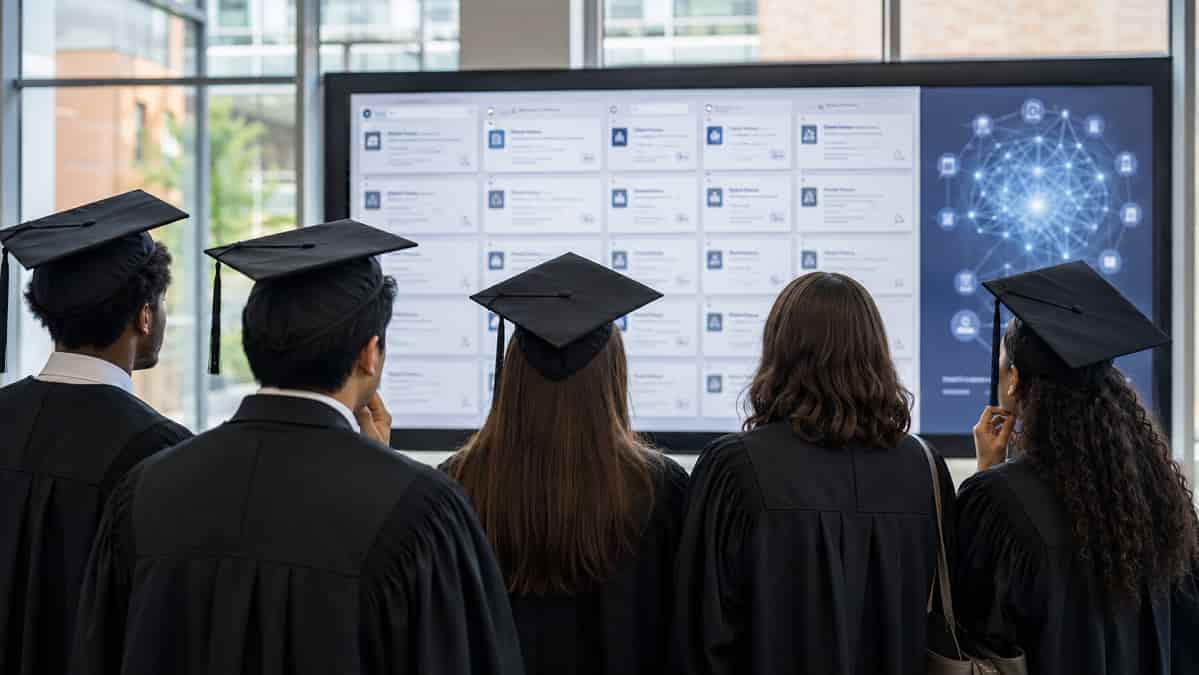
Britain’s graduates are entering a jobs market that is not simply shrinking. It is changing beneath their feet.
Traditional entry-level opportunities are becoming harder to secure, employers are demanding more practical experience, and artificial intelligence is beginning to perform some of the routine work that once helped graduates establish their careers.
The immediate figures are sobering. UK job postings fell by 11 per cent between the beginning of 2026 and 17 July, while graduate vacancies were 7 per cent lower than a year earlier. Graduate job postings were also at their lowest seasonal level since 2020.
Yet the same labour market data revealed something equally important: by the end of June, AI tools and related skills appeared in a record 9.4 per cent of UK job advertisements. The number of conventional openings may be under pressure, but the value placed on AI capability is rising rapidly. Reuters reported the findings from recruitment platform Indeed.
The central question is therefore not whether graduates should use AI. It is whether education institutions are equipping them to use it intelligently, responsibly and productively.
Are graduates prepared for an AI-driven workplace?
Many students already use generative AI to research subjects, summarise information and improve written work. But familiarity with a chatbot is not the same as workplace readiness.
Employers increasingly want people who can choose the correct tool, write effective instructions, check outputs, protect confidential information and recognise when an apparently convincing answer is wrong.
Research from the Institute of Student Employers found that 87 per cent of employers expect AI to reshape graduate and apprentice roles. However, the research does not suggest that every entry-level job is about to disappear. Forty per cent of surveyed employers expected no roles to be replaced by AI over the following three years, while 42 per cent anticipated that only a small proportion would be affected.
The more immediate development is a change in tasks. Routine administration, basic data handling and formulaic writing may decline, while critical thinking, communication, adaptability, judgement and AI literacy become more valuable.
That distinction matters. Graduates are not necessarily competing directly against artificial intelligence. They are increasingly competing against other candidates who know how to use it effectively.
Where education institutions must improve
Universities and colleges are responding, but progress remains uneven. Some have introduced AI modules, practical assessments, employer projects, work placements and guidance on responsible use. Others still treat AI primarily as an academic-integrity problem.
Education providers need to move beyond debating whether students should use the technology. They must teach students how to work alongside it.
A credible AI-ready graduate should be able to:
- select an appropriate tool for a particular task
- produce clear prompts and improve them through testing
- verify AI-generated claims against reliable sources
- identify bias, fabrication and weak reasoning
- protect personal, commercial and workplace information
- explain where human judgement remains essential
- demonstrate what they personally contributed to a project
- combine technical confidence with communication and sector knowledge
This must be backed by genuine workplace exposure. A government examination of entry-level recruitment found a significant mismatch between what candidates commonly offer and what employers need. Graduates frequently present broad analytical knowledge, while businesses seek operational abilities such as data governance, cloud platforms, document management and production-ready processes.
Qualifications remain valuable, but employers increasingly want evidence that a candidate can apply knowledge to a real problem.
The Workers Union backs responsible AI adoption
The Workers Union has maintained a positive and forward-looking position on artificial intelligence. It has been a strong supporter of responsible artificial intelligence for several years. It began adopting AI technology as early as 2019, well before generative AI became a mainstream workplace tool.AI should not be presented solely as a threat to workers or as a convenient justification for reducing entry-level opportunities. Properly introduced, it can remove repetitive work, improve access to information, increase productivity and help workers develop valuable new capabilities.
However, being pro-AI also means being realistic about disruption.
Employers must not expect graduates to arrive with advanced AI skills if education, training and meaningful work experience have not kept pace. Businesses benefiting from greater productivity should invest in structured development, transparent recruitment and clear routes into employment.
Graduates should be trained to challenge AI outputs, not merely accept them, and to use technology as a professional tool rather than a substitute for original thought.
What can graduates do now?
Graduates should avoid describing themselves simply as “proficient in AI”. Employers will expect evidence.
Candidates can strengthen applications by building a small portfolio showing how AI helped them research a market, analyse information, automate an administrative process or improve a project. They should document the instructions used, how outputs were verified and what decisions required human judgement.
Free support is becoming more widely available. The government has opened benchmark-aligned AI foundation training to UK adults, with a stated ambition to help ten million workers develop practical AI capabilities by 2030.
Skills England has also identified communication, critical thinking and analytical ability as essential foundations for working with AI. These human capabilities may ultimately prove more durable than familiarity with any single platform.
The graduate jobs market is undoubtedly difficult. But the answer is not to race machines at routine work. It is to develop the judgement, practical experience, confidence and human understanding required to use powerful technology well.