
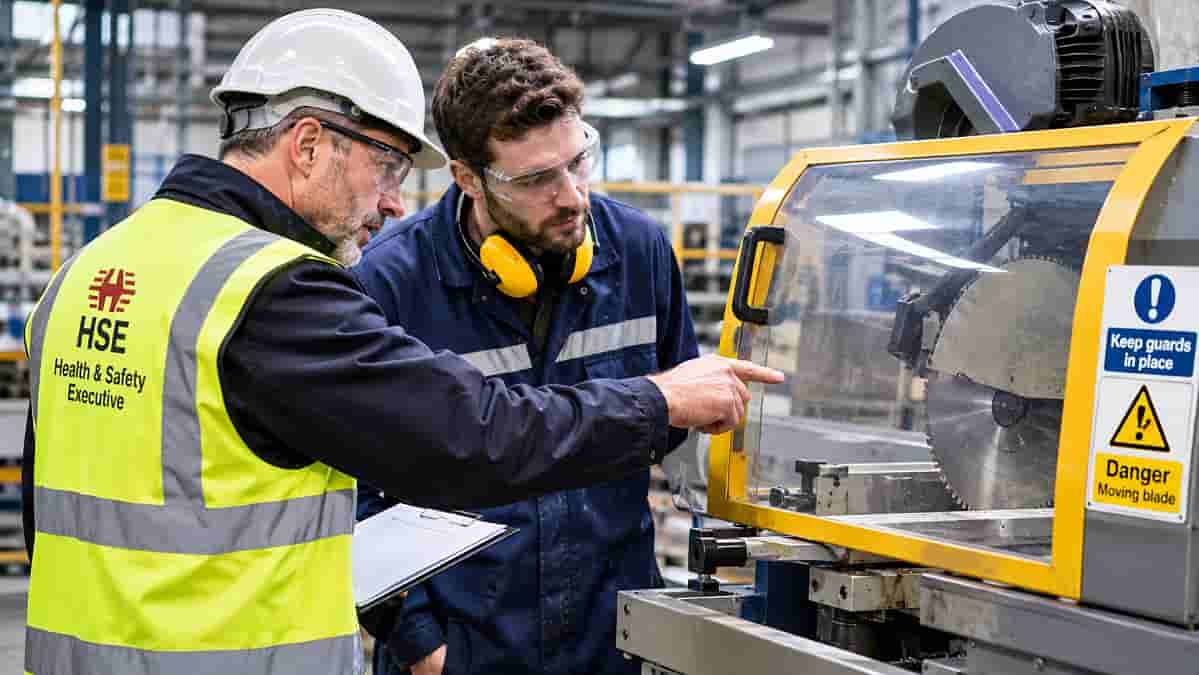
A young engineering worker has suffered a permanent injury after his hand came into contact with a moving saw blade at a Northamptonshire factory, prompting a prosecution that has once again exposed the potentially devastating consequences of inadequate machinery guarding.
Thomas Davies, aged just 21, lost part of a finger while working for Dlinexsign Ltd at the Buckingham Road Industrial Estate in Brackley.
The incident occurred when he reached into an automatic saw to retrieve a piece of cut material. His hand came into contact with the moving blade, resulting in a partial finger amputation.
According to the Health and Safety Executive’s official investigation, the machinery had not been adequately guarded to prevent employees from reaching dangerous moving components.
The case raises serious questions about how workers are protected when operating industrial machinery, particularly when seemingly routine tasks expose them to potentially life-changing injuries.
Young engineering worker suffers permanent finger injury
The accident happened while Mr Davies was operating an automatic saw designed to cut lengths of material. After completing a cutting operation, he reached into the machinery to retrieve a finished piece.
However, the equipment allowed access to the moving blade. Within moments, an ordinary workplace activity resulted in a serious injury.
The HSE investigation established that the employer had failed to implement effective measures preventing access to the dangerous parts of the machine.
Although the exact date of the original accident has not been specified in the published enforcement report, the consequences were serious enough to result in criminal proceedings.
For a worker aged just 21, an injury involving the loss of part of a finger can have lasting implications for everyday activities, employment and future career choices.
The full long-term impact on Mr Davies has not been publicly detailed.
Engineering company fined £20,000 and ordered to pay compensation
Dlinexsign Ltd, of Shires Road, Brackley, pleaded guilty to breaching Regulation 11(1) of the Provision and Use of Work Equipment Regulations 1998.
At Milton Keynes Magistrates’ Court on 23 October 2026, the company received the following penalties:
- £20,000 fine for the health and safety offence.
- £15,000 compensation ordered to be paid to Mr Davies.
- £9,064.34 prosecution costs.
The combined financial orders totalled £44,064.34.
Importantly, the compensation payment was separate from the criminal fine and prosecution costs. The prosecution followed an investigation by the HSE, which concluded that the incident could have been prevented through effective machinery guarding.
What went wrong with the factory machinery?
The central safety failure concerned access to dangerous moving parts.
Industrial saws can cause severe injuries when workers are able to reach cutting blades before hazardous movement has stopped.
Under the Provision and Use of Work Equipment Regulations 1998, employers must take effective measures to prevent access to dangerous parts of machinery or stop dangerous movement before workers enter a hazardous area.
Depending on the equipment, appropriate safeguards may include fixed guards, interlocked access doors and other protective devices. The HSE’s machinery safety guidance explains how employers should assess risks and prevent contact with hazardous components.
These protections are particularly important when workers need to retrieve finished materials, clear obstructions or carry out cleaning and maintenance.
Employees should not be placed in situations where completing an ordinary task requires them to reach into machinery that remains dangerous.
HSE warns that the accident was preventable
Following the prosecution, HSE inspector Dulanjala Kandana-Arachchige emphasised the importance of preventing access to moving machinery.
The inspector explained that employers must ensure equipment is properly guarded and that employees are protected from dangerous moving components.
The regulator concluded that the incident was preventable.
This is a particularly important finding because it demonstrates that workplace accidents are not always unavoidable consequences of industrial employment.
Where suitable protective equipment and safe working arrangements are available, employers have responsibilities to identify risks and implement appropriate safeguards.
Another machinery injury raises concerns for UK factory workers
The prosecution follows another serious case recently highlighted by The Workers Union.
In that incident, a female factory worker employed by Duni Poppies Limited in St Helens suffered devastating hand injuries when her hand became trapped between machinery rollers.
The employee lost two fingers completely and suffered partial amputations to another two.
Her employer was fined £80,000 after investigators identified failures involving machinery guarding.
Although the two cases involved different employers and circumstances, both demonstrate the consequences of employees being able to access dangerous moving equipment.
They also reinforce the importance of ensuring that safety arrangements remain effective throughout normal production activities.
What rights do workers have when machinery is unsafe?
Under the Health and Safety at Work etc. Act 1974, employers have a duty to ensure, so far as reasonably practicable, the health, safety and welfare of employees.
Workers should receive suitable information, instruction and training concerning the equipment they operate. Employers must also ensure machinery is appropriately maintained and that foreseeable hazards are properly controlled.
Where employees identify missing guards, defective safety switches or other dangerous conditions, concerns should be reported promptly through the employer’s established safety procedures. Workers can also obtain information about reporting workplace health and safety concerns directly to the HSE.
Employees who have suffered an accident may also need guidance about sickness absence, workplace adjustments and potential legal remedies.
Further information is available through the workplace support and guidance service.
Employers must ensure safe systems of work
The Brackley prosecution provides a clear warning to employers operating automatic cutting machinery.
It is not enough for equipment to function efficiently.
Machinery must also be safe for employees carrying out the tasks reasonably expected of them.
That includes retrieving materials, inspecting completed products and responding to routine operational problems. Employers should review whether protective guards are correctly installed, whether safety interlocks operate effectively and whether employees have received appropriate instruction.
The HSE’s guidance on the safe use of work equipment provides further information about these responsibilities. Where dangerous moving components remain accessible, employers should take corrective action before workers are exposed to unnecessary risks.
A young worker’s injury that should never have happened
The loss of part of a finger is a serious outcome for any employee. For someone at the beginning of their working life, it is an especially troubling reminder of how quickly an ordinary task can result in permanent harm.
The £20,000 fine and £15,000 compensation order demonstrate the legal consequences that can follow failures to protect employees from hazardous machinery.
However, financial penalties cannot reverse the injury itself.
The wider lesson for employers is that effective guarding, proper risk assessments and safe operating procedures must be fundamental parts of every industrial workplace.
No worker should have to risk permanent injury simply to retrieve a piece of material from a machine.