UK workers have received encouraging news after fresh research revealed that British employers increased their median pay awards to 3.2%, marking an improvement in wage settlements during the latest reporting period.
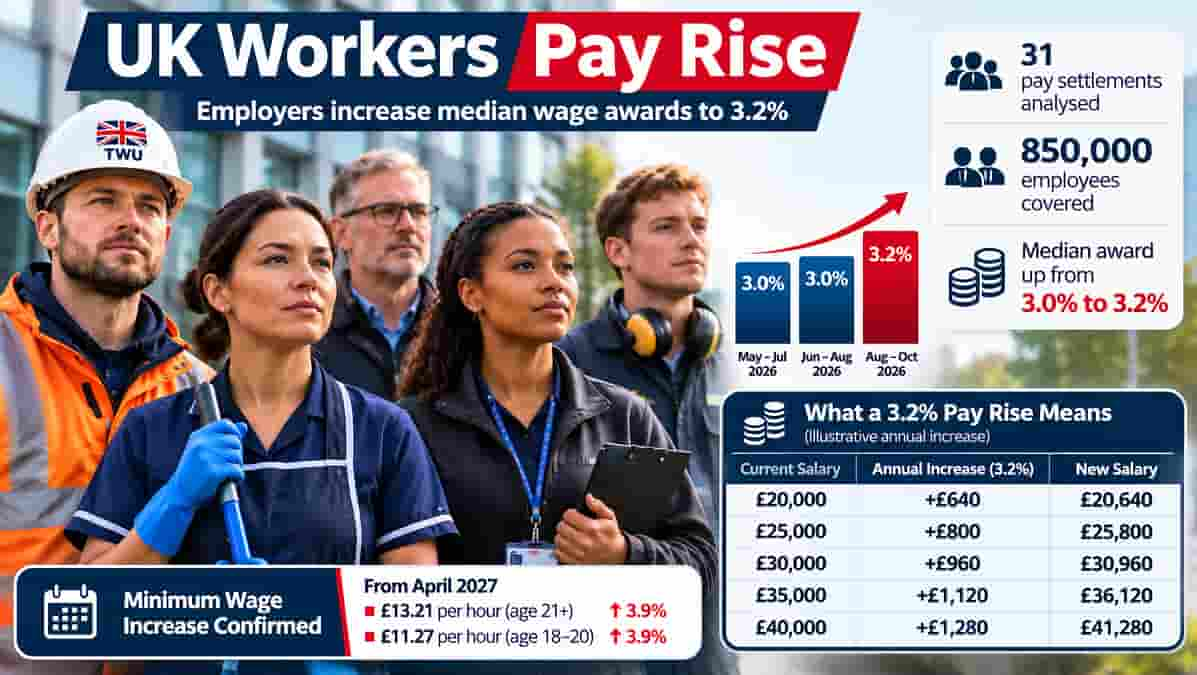
The findings, published today by employment research specialists Brightmine, show that the median pay increase awarded by UK employers rose from 3.0% to 3.2% in the three months ending October 2026.
The research examined 31 pay settlements covering approximately 850,000 employees, providing a substantial indication of how employers are approaching wage increases.
According to Reuters’ report on the latest UK employer pay awards, the improvement follows three consecutive rolling quarterly periods in which the median settlement remained at 3.0%.
For British workers, the increase is a welcome development, although the figures also show that pay awards remain below levels recorded earlier in 2026.
UK employers increase pay awards to 3.2%
Brightmine’s latest analysis covers pay settlements implemented between 1 August and 31 October 2026. The median settlement increased to 3.2%, compared with 3.0% in each of the preceding three-month periods ending in July, August and September.
The research also found that nearly half of employers included in the analysis awarded pay increases between 3.0% and 3.5%.
These figures concern agreed employer pay awards rather than the average earnings of every employee across Britain.
Nevertheless, they provide evidence that some UK employers have increased the percentage pay rises awarded to their existing workforce.
The improvement comes during a period of continued economic uncertainty, with businesses facing higher employment costs and workers experiencing pressure on household finances.
What does a 3.2% pay rise mean for UK workers?
The financial value of a 3.2% increase depends on an employee’s existing salary.
For illustration, a worker earning £25,000 annually would receive an additional £800 in gross annual pay if awarded a 3.2% increase.
A worker earning £30,000 would receive an additional £960, while someone earning £40,000 would receive £1,280 more annually.
These examples demonstrate the monetary value of the reported median settlement. They do not mean every employee covered by the survey received precisely 3.2%.
| Existing annual salary | 3.2% increase | New annual salary |
| £20,000 | £640 | £20,640 |
| £25,000 | £800 | £25,800 |
| £30,000 | £960 | £30,960 |
| £35,000 | £1,120 | £36,120 |
| £40,000 | £1,280 | £41,280 |
Figures are illustrative, before income tax, National Insurance and other deductions.
Public-sector workers included in latest pay settlements
The Brightmine research includes substantial numbers of public-sector employees. Several public-sector pay settlements within the latest sample provided increases ranging from 3.5% to 3.8%.
These awards form part of the wider analysis covering approximately 850,000 employees. The inclusion of public-sector settlements is significant because the pay decisions affecting these employees contribute to the overall median reported by Brightmine.
However, the findings do not establish that every NHS employee, teacher, council worker or other public-sector employee received an increase within this range. Actual awards depend on the relevant employment arrangements and pay decisions.
The latest Office for National Statistics labour-market figures provide additional information about differences between public-sector and private-sector earnings.
UK minimum wage to increase by 3.9% in April 2027
The latest employer pay figures follow the Government’s announcement of a 3.9% increase in statutory minimum wage rates, scheduled for April 2027. The National Living Wage for workers aged 21 and over is set to increase from £12.71 to £13.21 per hour.
For workers aged 18 to 20, the statutory minimum hourly rate is set to rise from £10.85 to £11.27. The Government announced that approximately 2.3 million of Britain’s lowest-paid workers would benefit from the changes.
The new rates were confirmed during the October Budget, as reported by Reuters. Employees can check the applicable statutory rates through the Government’s National Minimum Wage guidance. The April 2027 increase is separate from the 3.2% median employer pay settlement reported today.
Wage increases remain under pressure from inflation
Although the latest figures show an improvement in employer pay awards, Brightmine has warned that settlements may fall further behind inflation in the coming months. The research organisation expects median pay awards to remain around 3.0% during 2027.
Higher employer National Insurance contributions and the forthcoming increase in statutory minimum wages are among the factors identified as placing pressure on businesses’ pay budgets.
Brightmine also raised concerns about the possibility of narrowing salary differences between workers receiving the statutory minimum and employees earning more because of additional experience or responsibilities.
This issue is particularly relevant to workers who have progressed into supervisory, technical or specialist positions. Where statutory minimum rates rise faster than general salary awards, the difference between pay grades can become smaller. However, the latest research does not establish that this has happened at every UK employer.
Official figures show UK workers’ earnings continue to increase
Separate official statistics released on 17 November provide further evidence of rising nominal pay. According to the ONS and HMRC PAYE earnings report, median monthly pay reached an estimated £2,669 in October 2026.
This represented an increase of 4.6% compared with October 2025. The figures measure pay received by employees through PAYE, rather than the percentage salary increases agreed by employers. They should therefore not be directly compared as though they measure the same thing.
The ONS also reported that annual regular earnings growth, excluding bonuses, slowed to 3.5% in the three months ending September. When adjusted for CPIH inflation, regular earnings increased by only 0.2%.
These figures demonstrate why nominal pay increases do not necessarily produce equivalent improvements in workers’ purchasing power.
Higher starting salaries offer another encouraging development
The latest pay settlement figures follow separate evidence of improving starting salary offers.
On 9 November, The Workers Union reported that UK starting salaries were rising despite weaker recruitment activity. The KPMG and REC UK Report on Jobs found that employers increased starting salaries for permanent positions at a faster rate during October.
However, the survey also identified a decline in permanent recruitment and temporary placements. Together, the two reports provide distinct evidence about pay conditions.
The KPMG and REC survey examines recruitment activity and starting pay, while Brightmine’s research examines employer pay settlements. Both indicate that some employers continue to increase remuneration, although neither establishes that every UK worker is receiving a higher salary.
What should UK workers know about their pay?
Employees reviewing their pay should distinguish between statutory minimum wage increases, contractual salary arrangements and discretionary employer awards. The law requires employers to pay at least the applicable National Minimum Wage.
However, workers do not automatically have a statutory entitlement to the median 3.2% settlement identified in Brightmine’s research. An employee’s entitlement to a higher rate may depend on their employment contract, an applicable pay arrangement or a specific employer decision.
Workers concerned about incorrect wages or contractual pay arrangements can access workplace help and employment guidance. Further information about pay and wages at work is available through Acas.
Encouraging pay news for Britain’s workforce
The latest Brightmine figures provide a positive development for UK workers, confirming that median employer pay settlements increased during the three months ending October. The rise from 3.0% to 3.2% is modest, but it is supported by research covering approximately 850,000 employees.
Separate official figures also confirm that nominal earnings continue to increase, while the Government’s announced minimum wage changes will provide higher statutory hourly rates from April 2027. Nevertheless, inflation and employment costs remain important factors affecting the value and sustainability of pay increases.
For Britain’s workforce and workers union members, the latest findings offer evidence of improved employer pay settlements without establishing that wage pressures have disappeared.
UK employers have increased their median pay awards to 3.2%. The next important measure will be whether future wage increases deliver sustained improvements in the purchasing power and living standards of British workers.