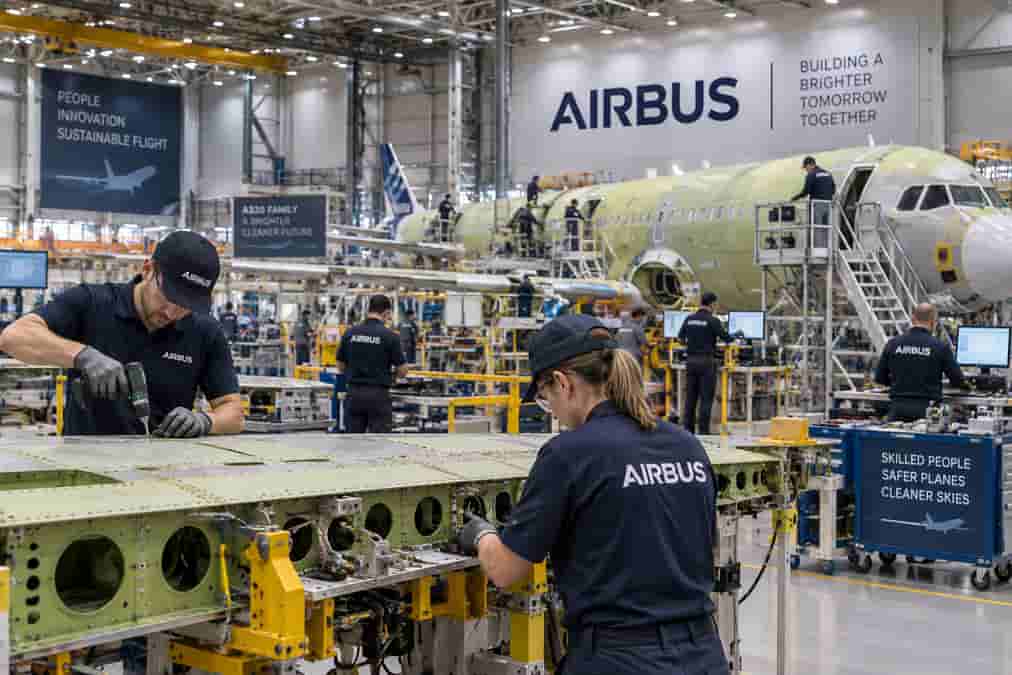
Hundreds of new skilled jobs are set to be created in North Wales as aerospace giant Airbus significantly expands its manufacturing operation at Broughton.
The company is preparing to increase its workforce at the Flintshire site by nearly 900 workers, representing an expansion of approximately 15% as Airbus responds to strong global demand for its aircraft.
Around 430 additional workers are expected to be recruited initially, adding to the approximately 6,000 people already employed at the Broughton complex. Airbus expects to recruit a similar number or potentially more during 2027 as production continues to increase.
For UK workers, the announcement provides a welcome positive employment story at a time when the wider labour market remains challenging.
It also reinforces the importance of aerospace, advanced engineering and manufacturing as sources of long-term skilled employment.
£150 million investment behind expansion
Airbus is investing an additional £150 million in its Broughton operation, including the transformation of the site’s West Factory.
The facility was previously used in connection with production of wings for the A380 superjumbo before production ended. It is now being repurposed to support the highly successful A321 programme.
Demand for the A321 is substantial.
Airbus reportedly has a backlog approaching 5,500 A321 aircraft, providing a strong pipeline of future manufacturing work.
The company delivered 793 commercial aircraft during 2025 and is targeting around 870 deliveries in 2026, with ambitions to increase annual production beyond 1,000 aircraft before the end of the decade.
The expansion at Broughton is therefore not simply about constructing a new facility. It is directly connected to the need for greater manufacturing capacity.
Broughton at the heart of British aerospace manufacturing
Broughton has a long history of aircraft manufacturing and today serves as an important centre for Airbus wing production.
The site currently produces wings for the A320 family, A330 and A350, with a workforce comprising aircraft fitters, engineers and supporting roles.
The wider UK Airbus operation is substantial.
Airbus says it directly supports more than 14,000 UK jobs, while its commercial aircraft operations at Broughton, Filton, Belfast and Prestwick sustain around 12,000 jobs and hundreds of apprenticeships. The company also reports spending around £4.5 billion with UK suppliers.
That wider supply chain is important.
Increasing aircraft production can create demand extending beyond the employees working directly inside the Broughton factory, supporting businesses involved in engineering, components, materials, logistics and specialist services.
Skilled workers could benefit from recruitment
The expansion could provide particularly valuable opportunities for workers with existing manufacturing and engineering experience.
Airbus’s Broughton recruitment information identifies backgrounds including sheet-metal work, metal fabrication, welding, mechanical fitting and HVAC as potentially relevant experience for skilled aircraft-fitting positions.
This is significant because it demonstrates how skills developed in one part of Britain’s manufacturing economy can potentially be transferred into aerospace.
Airbus says it regularly onboards new cohorts of skilled aircraft fitters at Broughton, with day and night-shift opportunities available through its contingent-work partner.
Workers interested in engineering and manufacturing opportunities can also use The Workers Union’s enhanced UK jobs service, which brings together live vacancies across engineering, technology, health, graduate employment and other sectors.
The service was expanded earlier this year to help workers find new opportunities quickly as the employment market changes.
Find your next opportunity through The Workers Union jobs service
Apprenticeships and opportunities for younger workers
There is another encouraging element to the announcement: the potential for continued development of Britain’s future aerospace workforce.
Airbus operates apprenticeships, graduate programmes, internships and placement opportunities across its UK operations.
The company’s current careers information confirms that recruitment is already being prepared for UK apprentices joining in September 2027, alongside graduate and placement opportunities.
These routes matter because advanced manufacturing requires a continuing supply of skilled workers.
Expanding production without developing the next generation of aircraft fitters, engineers, technicians and manufacturing specialists would make long-term growth difficult to sustain.
For young workers deciding whether university is their preferred route, aerospace apprenticeships can also provide an alternative pathway into highly skilled employment.
Explore Airbus careers, apprenticeships and graduate opportunities
A positive sign for UK manufacturing
The announcement comes against a complicated background for British workers.
The Workers Union has been closely following changes in recruitment throughout 2026, including signs that parts of the employment market have started to stabilise.
Our earlier analysis, UK jobs market shows signs of recovery as temporary hiring surges across Britain, highlighted manufacturing and engineering among areas continuing to offer opportunities even while permanent recruitment across the wider economy remained under pressure.
The Airbus expansion strengthens that picture.
It should not be interpreted as evidence that Britain’s entire labour market has suddenly recovered. Workers in several industries continue to face restructuring, redundancy and cautious recruitment.
But there is a meaningful distinction between temporary recruitment intended to deal with a short-term increase in demand and a manufacturer investing £150 million in additional production capacity while planning to increase a 6,000-strong workforce by approximately 15%.
That suggests confidence in the longer-term requirement for both production and skilled labour.
Aerospace skills remain valuable to UK workers
The aerospace sector also demonstrates the value of specialist skills.
Earlier this year, more than 1,000 aerospace professionals at BAE Systems sites in Lancashire secured an improved pay settlement after a long-running dispute.
The Workers Union reported how the agreement affected highly skilled employees working across important UK aerospace facilities and highlighted the growing importance of recruiting and retaining specialist engineering talent.
Read: More than 1,000 BAE Systems workers secure improved pay settlement
Taken alongside the Airbus recruitment announcement, it provides further evidence that skilled aerospace and engineering workers remain important to Britain’s industrial economy.
Opportunities beyond North Wales
Although the new positions will primarily benefit workers in and around North Wales, Broughton’s location gives the expansion a wider employment footprint.
Airbus describes the site as being within easy reach of Chester, Wrexham, Birkenhead, Liverpool and Warrington, potentially opening opportunities to workers across a substantial part of North Wales and North West England.
The wider economic impact could reach further still through suppliers and businesses supporting Airbus production.
For workers considering a career change, this is also a reminder that manufacturing increasingly encompasses advanced technology, precision engineering, quality control, digital systems and highly specialised production processes.
The Workers Union view
At a time when many workers are understandably concerned about redundancies, automation and uncertainty in the employment market, substantial investment that leads directly to new UK jobs should be recognised as an encouraging development.
Nearly 900 additional positions at one of Britain’s most important aerospace manufacturing sites could provide opportunities for experienced workers, people transferring from other manufacturing industries and a new generation entering engineering through apprenticeships and early-career programmes.
The Workers Union believes that a resilient employment market depends not simply on the number of vacancies available, but on Britain’s ability to maintain secure, skilled and sustainable employment.
Investment in manufacturing facilities must therefore go hand in hand with investment in the people who design, build, maintain and improve the products produced within them.
The £150 million investment at Broughton and the substantial expansion of its workforce provide a positive example of what that relationship can look like. And for those considering aerospace specifically, Airbus’s Broughton production careers page provides information about current skills requirements and recruitment routes.