
Understanding legal funding: Your options for starting legal action against an employer
Facing workplace issues is daunting enough without the added stress of legal costs. Whether you’ve been unfairly dismissed, discriminated against, or denied pay entitlements, accessing justice shouldn’t be out of reach. In the UK, a variety of legal funding options exist to help individuals initiate claims against employers, ranging from insurance-backed support to private client arrangements.
This page will guide you through the different legal funding routes available and help you understand which one may be suitable for your circumstances.
What is legal funding?
Legal funding refers to financial support available to cover the costs of bringing legal proceedings, including claims made to the employment tribunal. Costs can include solicitor fees, court fees, and in some cases, expert witnesses. Choosing the right funding method is essential to ensure you are not exposed to unexpected legal bills.

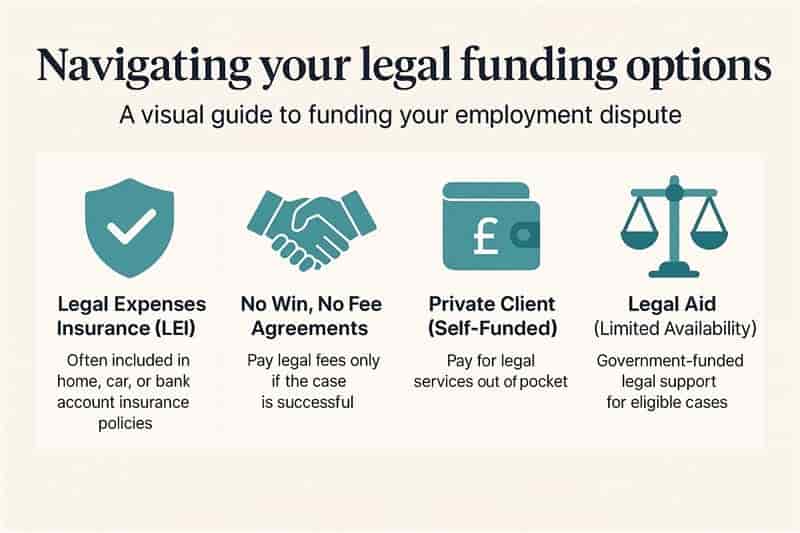
Types of legal funding available for employment disputes
- Legal expenses insurance (LEI)
Legal expenses insurance is one of the most accessible and underutilised forms of legal support in employment claims. It is often included as an add-on or benefit within home insurance, motor insurance, or even bank accounts and credit cards.
Where to check:
- Home insurance policies
- Car insurance agreements
- Premium current accounts (offered by banks)
- Credit card protection services
If you have a valid LEI policy, you may be able to access funding for solicitor costs and tribunal representation—subject to policy limits and terms. You must notify the insurer promptly once a dispute arises to ensure eligibility.
Key advantages:
- Pre-approved panel solicitors
- Covers most employment tribunal-related legal costs
- Peace of mind for those unaware they already hold this cover
- No win, no fee agreements (Conditional Fee Arrangements)
No win, no fee agreements, also known as conditional fee arrangements, are common in personal injury and employment claims. Under this agreement, you don’t pay your solicitor’s legal fees unless your case is successful. If you win, a success fee may be deducted from your compensation.
This option reduces financial risk but does come with caveats. The success fee can be up to 35% of the final settlement, and disbursements (e.g., medical reports, barrister fees) may be excluded unless separately insured.
Key advantages:
- No upfront costs
- Incentive for legal providers to succeed in your case
- Often paired with After-the-Event (ATE) insurance to cover risk
- Private client (self-funded legal support)
Some individuals prefer or are required to pay for legal advice independently. This is typically known as a private client arrangement. Solicitors charge hourly rates or fixed fees for particular services, such as drafting a grievance letter or representing you at a hearing.
Private funding may be necessary if:
- You do not qualify for LEI
- Your claim is complex and exceeds insurance cover
- You prefer full control over your legal representation
While flexible, private funding can be expensive, and it’s advisable to request a breakdown of charges before proceeding.
Key considerations:
- Ensure transparency in fee structure
- Discuss budget constraints upfront
- Look for firms offering fixed-price packages
- Legal aid (limited availability)
In general, legal aid is not available for employment disputes. However, exceptions exist for claims involving discrimination under the Equality Act 2010, especially where the claimant is vulnerable or the dispute involves a breach of fundamental rights.
Legal aid is income and means-tested and typically only available through specialist legal aid solicitors or community law centres.
Making the right choice: What to consider before proceeding
Before initiating legal proceedings against an employer, always:
- Review your insurance policies for hidden LEI cover
- Discuss risk and cost with your nominated solicitor
- Understand success fees and disbursements in no win-no fee cases
- Obtain written confirmation of any funding arrangements
It is also advisable to seek preliminary legal advice, which may be offered on a fixed-fee or free consultation basis, before choosing your funding route.
Boosting your claim’s success with proper funding
Choosing the right legal funding option can make the difference between accessing justice or facing a financial shortfall. Whether through a forgotten insurance policy, a flexible no win-no fee arrangement, or direct funding, it’s essential to start from an informed position. Our resources are here to guide you through the legal system with dignity, clarity, and confidence.
At The Workers Union, we believe that no one should be denied access to justice due to a lack of funding. Stay informed. Stay empowered.
Frequently Asked Questions
Legal funding refers to financial arrangements that support legal costs. It helps workers access justice.
Common options include insurance, fixed‑fee agreements, and conditional arrangements. Availability varies by case.
Costs depend on complexity and representation. Workers should request clear fee information.
Some workers may have access to support through policies or advice services. Understanding options is essential.
It is a conditional arrangement where fees apply only if the case succeeds. Terms should always be reviewed.
Certain funding methods may carry financial obligations. Workers should understand terms before agreeing.
The Workers Union helps workers understand funding options. Guidance supports informed decisions.

I want to join
Join us today – it’s easy!
You’re just a few clicks away from investing in a better future for working people

I’m a member
All the support and advice you need
Log in to your account. Full access to your resources, contacts, personal dashboard, and instant advice.