
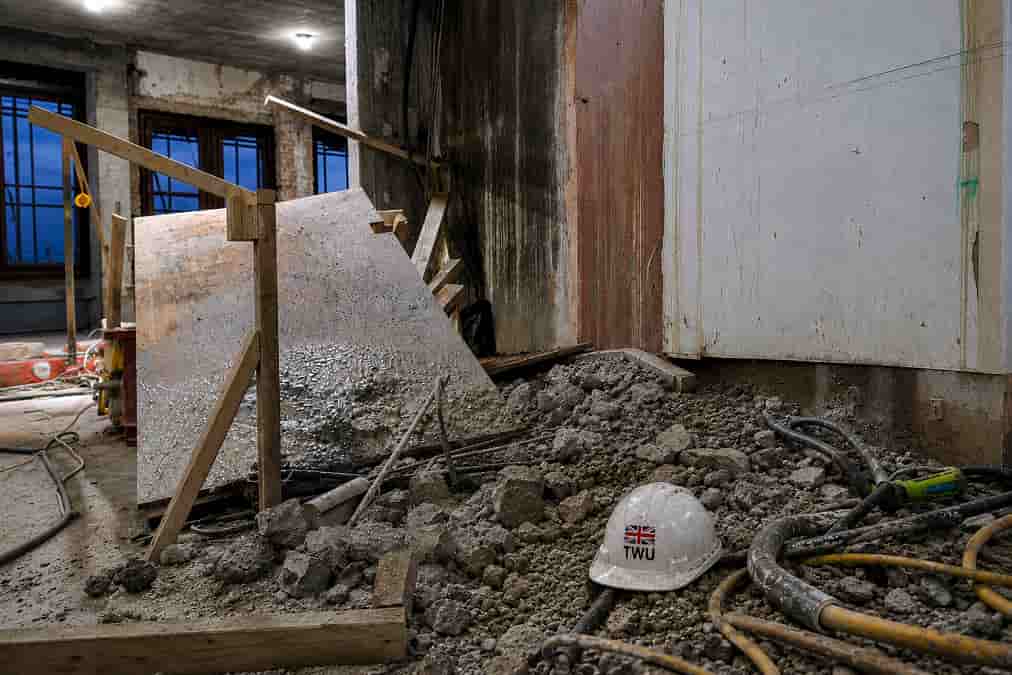
Two construction companies have been fined after a worker suffered life-changing injuries when a temporary platform loaded with concrete debris collapsed on top of him during a refurbishment project in the City of London.
The incident happened on 23 February 2024 at Paxton House, where major refurbishment works were underway. The project was being managed by Roots Contractors Limited, while specialist drilling contractor Diacutt Limited had been engaged to cut openings through five concrete floors to create a service riser shaft.
During the works, temporary wooden platforms had been constructed beneath each floor opening to collect concrete cores and debris generated by drilling operations.
However, one of those platforms failed catastrophically.
Drilling operative Steve Zschoch, now aged 60, had been working on the third floor when the platform above him suddenly gave way. The collapse sent both the structure and accumulated concrete debris crashing down onto him.
Mr Zschoch suffered serious workplace injuries, including fractures to his neck and back, as well as a bleed on the brain.
Describing the moment of impact, he said he was “folded up like a concertina”.
The consequences have been devastating.
“The impact this incident has had on me has been life changing in so many ways,” he said.
“Not just in mobility issues but in my confidence to do just about anything.
“Even simple domestic tasks, like using the launderette or going to the shops can overwhelm me now. Emotionally as well as physically.”
The incident ultimately brought his construction career to an early end.
HSE investigation uncovered significant failings
An investigation by the Health and Safety Executive (HSE) found a series of failures relating to the planning, design and management of temporary works on site.
Inspectors discovered there was no formal design for the temporary platforms and no calculations had been carried out to establish how much weight they could safely support.
Although inspection paperwork had been completed, the checks failed to identify defects in the platform design. HSE also found that the individual carrying out inspections was not a competent temporary works coordinator.
Workers had reportedly been verbally instructed to clear concrete debris regularly and avoid overloading the platforms. However, there was no established safe loading limit, no monitoring system and no effective supervision to ensure debris was removed.
Further shortcomings were identified in the planning and coordination of the drilling operations.
Risk assessments and method statements provided by Diacutt Limited were found to be inconsistent, while requirements relating to the provision of protective crash decks lacked clarity.
HSE also found there had been no direct supervision of the drilling team by Diacutt management during the week leading up to the incident or on the day of the collapse.
While operatives understood they should not work directly beneath one another, there was confusion regarding work locations and responsibilities, creating additional safety risks.
Companies fined
At Westminster Magistrates’ Court on 11 June 2026:
- Roots Contractors Limited of Ewell, Surrey, pleaded guilty to breaching Regulation 16(2) of the Construction (Design and Management) Regulations 2015.
- The company was fined £19,333 and ordered to pay costs of £5,548.
Diacutt Limited of Croydon pleaded guilty to breaching Regulation 15(2) of the same regulations.
- The company was fined £13,000 and ordered to pay costs of £5,548.
HSE issues warning on temporary works
HSE Inspector Lucy Ellison-Dunn said:
“People rightly expect that when they go to work, they are not put in unnecessary danger, and this entirely avoidable incident had the effect of seriously injuring Mr Zschoch and ending his construction career much earlier than he wanted.
“Those providing temporary works have a duty to ensure that any temporary structure is properly designed and constructed to withstand any foreseeable load that might be imposed on it.
“This means having appropriate arrangements in place to manage temporary works. Contractors should ensure all construction work is properly planned, managed and monitored to ensure workers can carry out their work safely.”
The prosecution was brought by HSE enforcement lawyers Chloe Ward and Jon Mack, supported by Thomas Smith.
Jonathan Morgan of The Workers Union said:
“This case highlights why temporary works management cannot be treated as a paperwork exercise. Every temporary structure on a construction site must be properly designed, assessed and monitored throughout its use.
Workers and our members have the right to expect that the structures around them have been engineered to withstand foreseeable loads and that competent supervision is in place to identify risks before somebody gets hurt.
The injuries suffered by Mr Zschoch are a stark reminder that when planning, communication and monitoring break down, the consequences can be devastating and permanent.
The Workers Union continues to encourage employers across the construction sector to review their temporary works procedures, supervision arrangements and site safety systems to ensure workers return home safely at the end of every shift.”