A plastics packaging manufacturer has been fined £60,000 after a worker suffered a severe crush injury when their hand was pulled into moving rollers during a cleaning operation in Telford.
But this was not the first serious machinery case involving the company. Reflex Flexible Packaging Limited had been fined £277,500 less than a year earlier following a fatal incident at another of its sites.
The latest case will inevitably raise difficult questions about whether lessons were learned quickly enough and whether workers across the business were being adequately protected from known machinery risks.
Worker required surgery after hand was trapped
The injured employee worked as a laminator operative and shift supervisor at the company’s Halesfield premises in Telford.
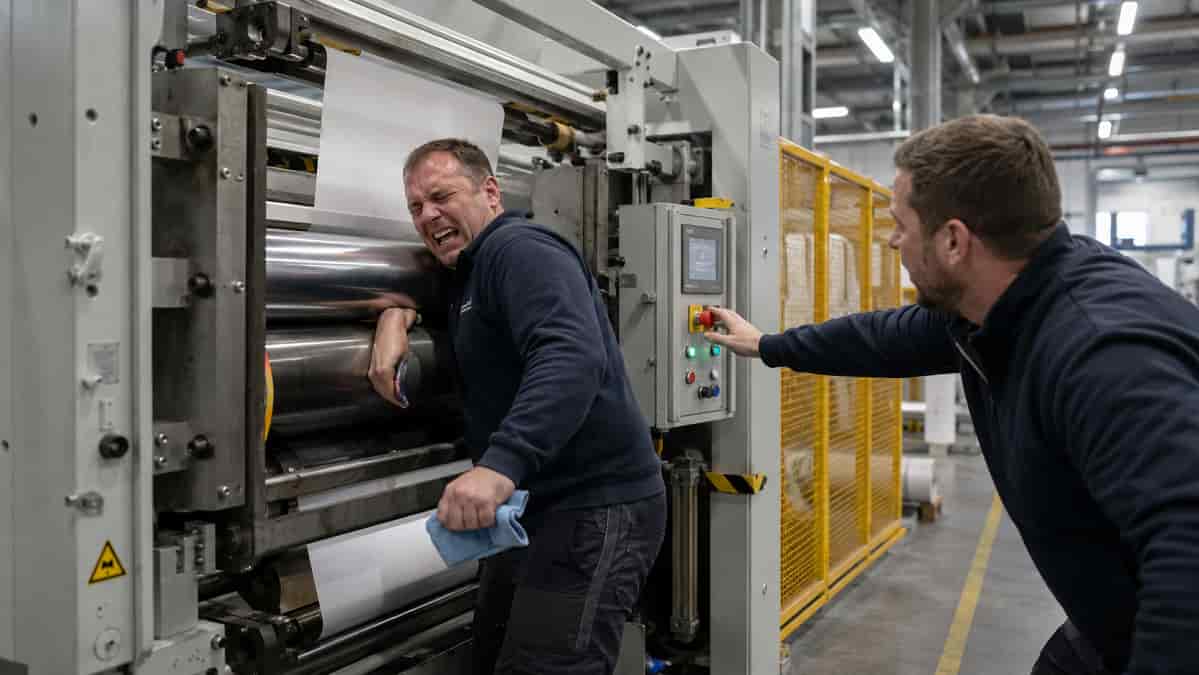
On 17 January 2025, the worker was cleaning the rollers of a laminating machine with rags after production had finished. One of the rags became caught between two moving rollers, pulling the worker’s left hand into the machinery up to the wrist.
A colleague activated the emergency stop, enabling the worker to release their hand. The employee was taken to hospital with a severe crush injury, underwent two operations, spent four nights in hospital and later required physiotherapy to rebuild strength in the injured hand.
The physical injury is only one part of the story. An incident of this kind can affect a worker’s confidence, independence and ability to continue performing their normal duties. It can also place pressure on their family while treatment and rehabilitation continue.
Fixed guard was not installed
An investigation by the Health and Safety Executive found that Reflex Flexible Packaging Limited had failed to provide effective measures preventing access to the dangerous moving parts of the machine.
According to the HSE investigation, a fixed guard had not been installed to stop workers reaching the dangerous nip point between the rollers during cleaning.
Investigators also found that the risk assessment and safe system of work were not suitable and sufficient. The cleaning process had not been properly assessed, and the possibility of a worker being pulled into the machine had not been identified.
Instructions concerning the foot pedal used to rotate the rollers during cleaning were also unclear.
The company pleaded guilty to breaching Regulation 11(1) of the Provision and Use of Work Equipment Regulations 1998. Birmingham Magistrates’ Court fined it £60,000 and ordered it to pay £4,464 in costs on 10 August 2026.
HSE Inspector Zach Morris described the incident as “entirely preventable”.
Second substantial fine in less than a year
The previous prosecution involved the death of 46-year-old employee Paul Whalley at the company’s Langley Mill factory in Derbyshire.
Mr Whalley died in May 2020 after entering an opening in a plastics conversion machine and becoming trapped in its moving parts. The HSE found that the company had failed to install suitable guarding and had not provided adequate risk assessments, written working procedures or isolation arrangements.
Reflex Flexible Packaging Limited was fined £277,500 in November 2025 and ordered to pay £20,000 in costs.
The two prosecutions concerned separate incidents and different sites. Nevertheless, they share a troubling feature: workers were exposed to dangerous moving machinery that had not been adequately guarded.
For The Workers Union, that similarity must be taken seriously. Workplace safety cannot be treated as a local problem confined to one machine, department or factory. Where a major failure is discovered, employers should consider whether comparable risks exist across every relevant site.
What should workers do about unsafe machinery?
Workers should never be expected to reach into moving machinery or clean dangerous components without effective safeguards.
Before cleaning, clearing a blockage, carrying out maintenance or attempting a repair, workers should receive clear instructions on how the equipment will be stopped and safely isolated. Machinery guards should not be removed, bypassed or defeated merely to make a task quicker.
Workers who believe equipment is unsafe should stop if there is a risk of immediate injury, move away from the danger and report the problem through the appropriate workplace safety procedure. Details should be recorded, including the machine involved, the date, the task being performed and any previous concerns raised.
Employers should ensure that risk assessments cover cleaning and maintenance as well as routine production. These are often the moments when workers are brought closest to rollers, blades, belts, gears and other moving components.
The Workers Union continues to place the safety of UK workers at the centre of its work. No production target or cleaning schedule is more important than ensuring that someone returns home safely at the end of their shift.