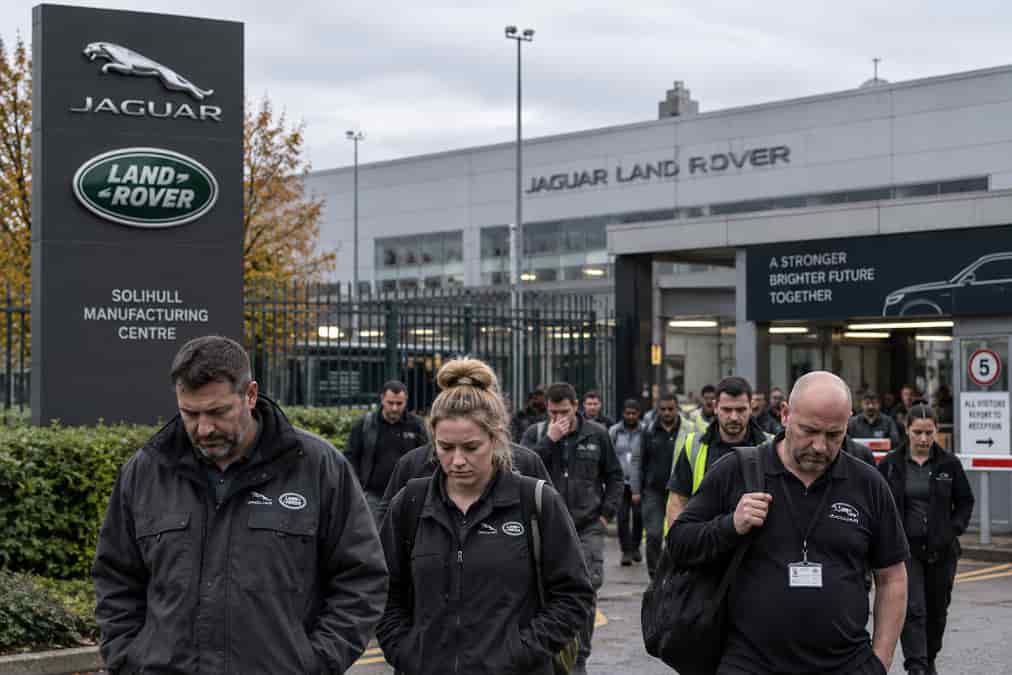
The UK Business Secretary, Jonathan Reynolds, has confirmed that he will meet Jaguar Land Rover chief executive PB Balaji this week as concern grows over plans that could see up to 4,000 salaried and management roles removed over the next two years.
JLR employs around 30,000 people in Britain, with its largest plant in Solihull and a substantial employment footprint across the West Midlands. The company has confirmed a voluntary redundancy programme as part of a plan to secure approximately £1.7 billion in savings.
The important new development is the Government response.
Reynolds said the purpose of the discussions would be to mitigate job losses, while acknowledging that conditions facing car manufacturers in Britain and Europe remain difficult. However, he has also ruled out a direct taxpayer-funded bailout of JLR.
That creates a more significant situation for workers than yesterday’s initial redundancy announcement.
The Government is now actively involved in discussions, but the message appears to be that assistance would need to focus on supporting the wider automotive sector and long-term investment rather than simply covering JLR’s financial losses.
For workers, the immediate distinction remains important: the programme currently confirmed by JLR is voluntary redundancy for salaried and management employees, rather than an announced compulsory redundancy programme affecting production workers.
Reports suggest the reductions could ultimately reach around 4,000 positions. The Financial Times reports that the restructuring is expected to exclude production-facility roles at this stage, concentrating instead on salaried and management employment.
Why this matters beyond JLR
The Workers Union should continue watching this closely because the bigger issue is the potential effect on the West Midlands automotive economy.
JLR is not an isolated employer. Its manufacturing operations support substantial numbers of jobs across engineering, logistics, component manufacturing, professional services and the wider automotive supply chain.
Even if frontline production jobs remain outside the current redundancy programme, a prolonged reduction in investment, vehicle volumes or engineering activity could eventually affect contractors and suppliers.
JLR says it is responding to a difficult global environment that includes weaker sales, international tariffs and increasing competition from Chinese vehicle manufacturers. The company is also still dealing with the longer-term financial impact of the major cyberattack that disrupted its operations last year.
There is therefore a wider UK worker issue emerging: established manufacturers are being required to cut costs at the same time that Britain is attempting to grow advanced manufacturing, electric vehicle production and other higher-skilled industrial employment.
Reuters: UK Business Secretary to meet Jaguar Land Rover CEO over job cuts