
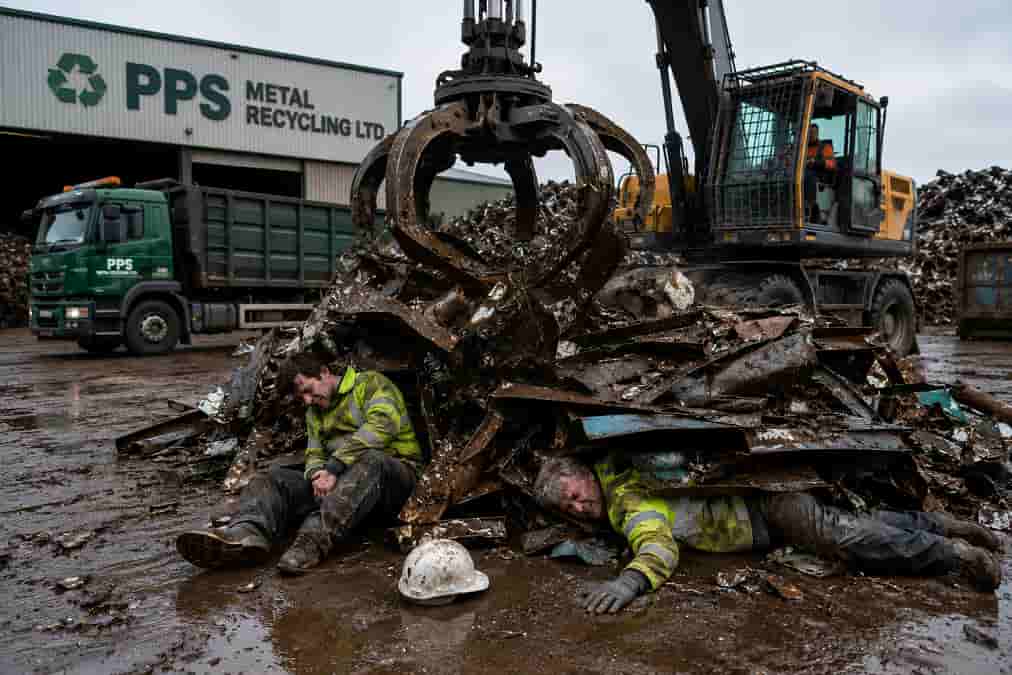
A scrap metal recycling company has been fined £40,000 after a father and son were injured when heavy scrap metal collapsed onto them, in a case that highlights the potentially devastating consequences of failing to properly separate people from workplace machinery and moving vehicles.
The incident happened at PPS Metal Recycling Ltd’s site in Scunthorpe on 6 February 2025 while the two men were unloading scrap metal.
A 360-degree excavator fitted with a grab attachment was operating nearby and removing material from a large stockpile. Part of the pile collapsed, sending heavy pieces of scrap metal towards the pair.
Both men required hospital treatment and one suffered a broken leg.
An investigation by the Health and Safety Executive (HSE) subsequently identified serious shortcomings in the arrangements for keeping people away from workplace transport, heavy machinery and unstable stockpiles.
Read the official HSE prosecution report
Excavator operated close to people for around 20 minutes
HSE investigators found that the excavator had been working close to members of the public for approximately 20 minutes before the accident.
Suitable controls had not been implemented to prevent people from being exposed to the risks created by the moving machinery and unstable piles of scrap metal.
The circumstances highlight a recurring workplace safety issue: simply having experienced operators or established working routines does not remove the need to physically manage the interaction between pedestrians, vehicles and mobile plant.
Where reasonably practicable, people and workplace vehicles should be kept apart.
HSE’s workplace transport guidance explains how employers can assess and control risks involving pedestrians and vehicles, including the design of traffic routes, reversing operations and the separation of people from moving equipment.
HSE guidance on workplace transport safety
Warning came just ten days before accident
One of the most concerning elements of the prosecution is that there had already been a warning that something could go seriously wrong.
On 27 January 2025 – just ten days before the father and son were injured – the rotating cab of the same excavator struck a member of the public’s vehicle while scrap was being unloaded.
Nobody was injured during that incident.
However, HSE concluded that the underlying safety failures involved in the near miss were the same as those subsequently identified following the more serious accident.
That makes this case particularly important for employers and workers.
A near miss should not simply be regarded as an accident that happened to cause no injury. It can provide valuable evidence that an existing working practice, traffic arrangement or safety control is inadequate.
Had the earlier incident resulted in effective corrective action, HSE said both incidents could have been prevented.
Company fined following HSE prosecution
PPS Metal Recycling Ltd pleaded guilty to breaching Section 3(1) of the Health and Safety at Work etc. Act 1974.
At Grimsby Magistrates’ Court on 1 September 2026, the company was fined £40,000 and ordered to pay £6,181 in costs.
Section 3 of the Act places duties on employers in relation to people who are not their employees but who could nevertheless be affected by the way the business operates.
Health and Safety at Work etc. Act 1974 – legislation
Following the incident, HSE issued a Prohibition Notice preventing the excavator from operating close to pedestrians.
The company subsequently introduced several additional safety measures, including a separate unloading area for members of the public, improved signage, supervised unloading, barriered pedestrian walkways and a traffic management plan.
Workplace transport continues to cause devastating injuries
This is far from an isolated example of the dangers created when pedestrians and heavy workplace vehicles operate in close proximity.
The Workers Union recently reported on an Aberdeen worker who suffered life-changing injuries following a forklift truck accident.
In that case, HSE found shortcomings in arrangements for safely managing vehicle and pedestrian movements during loading and unloading activities.
Read our previous report: Forklift truck injury leaves Aberdeen worker with life-changing injuries.
Another case covered by The Workers Union involved a construction worker who was seriously injured when a dumper truck overturned into an unprotected excavation. The HSE prosecution highlighted the importance of workplace transport controls and the proper use of vehicle safety equipment.
Read more: Dumper truck overturn leaves worker seriously injured.
Together, these cases demonstrate that workplace transport safety is relevant far beyond traditional haulage. Forklifts, excavators, loading vehicles, mobile plant and other moving equipment are routinely found across factories, warehouses, construction sites, recycling facilities and logistics operations.
Machinery safety remains another major concern
The risks are not limited to moving workplace vehicles.
Recent prosecutions have also demonstrated what can happen when workers are able to come into contact with dangerous parts of machinery.
The Workers Union recently reported on a plastics packaging manufacturer that was fined after a worker’s hand was pulled into moving laminator rollers during cleaning.
HSE found that effective measures had not been provided to prevent access to dangerous moving parts, while the risk assessment and safe system of work were also found to be inadequate.
Read our report: Second machinery workplace injury raises serious questions after worker’s hand crushed.
In another recycling-sector prosecution, HSE reported that a worker suffered life-changing injuries after being pulled into a conveyor while attempting to clear a blockage. The regulator identified failures involving guarding and the system of work used for clearing machinery.
HSE guidance on the safe use of work equipment and machinery
What should workers look out for?
Workers operating around workplace vehicles or heavy machinery should be particularly alert to situations where pedestrians and vehicles routinely share the same space.
Warning signs can include poorly defined pedestrian routes, vehicles reversing through areas used by workers, inadequate barriers, blind corners, machinery operating close to loading areas and safety procedures that exist on paper but are routinely ignored in practice.
Near misses should also be reported.
If a forklift narrowly misses a worker, an excavator strikes an object, a vehicle enters a pedestrian area or a machine unexpectedly moves during cleaning or maintenance, the fact that nobody was injured does not mean the incident was harmless.
It could be an opportunity to prevent the next incident from becoming considerably more serious.
Spokesperson Jonathan Morgan for TWU said..
“The latest prosecution provides a clear reminder that workplace safety should be proactive rather than reactive.
Employers should not have to wait for somebody to suffer a broken leg, crush injury or other life-changing injury before weaknesses in workplace traffic management become apparent.
Near misses, employee concerns and previous incidents can all provide warning signs that existing arrangements need to be reviewed.
The Workers Union believes workers should be able to carry out their jobs without being unnecessarily exposed to moving vehicles, inadequately controlled machinery or unsafe working practices.
The lesson from this prosecution is particularly powerful because there was an earlier warning.”
Nobody was injured the first time. Ten days later, two people were taken to hospital.
Employers across the UK should ensure that near misses are investigated properly, lessons are acted upon and effective safety controls are introduced before an avoidable accident occurs.
Related Workers Union coverage: Forklift truck injury leaves Aberdeen worker with life-changing injuries | Dumper truck overturn leaves worker seriously injured | Worker’s hand crushed in machinery incident
External resources: HSE – PPS Metal Recycling prosecution | HSE workplace transport guidance | HSE work equipment and machinery guidance