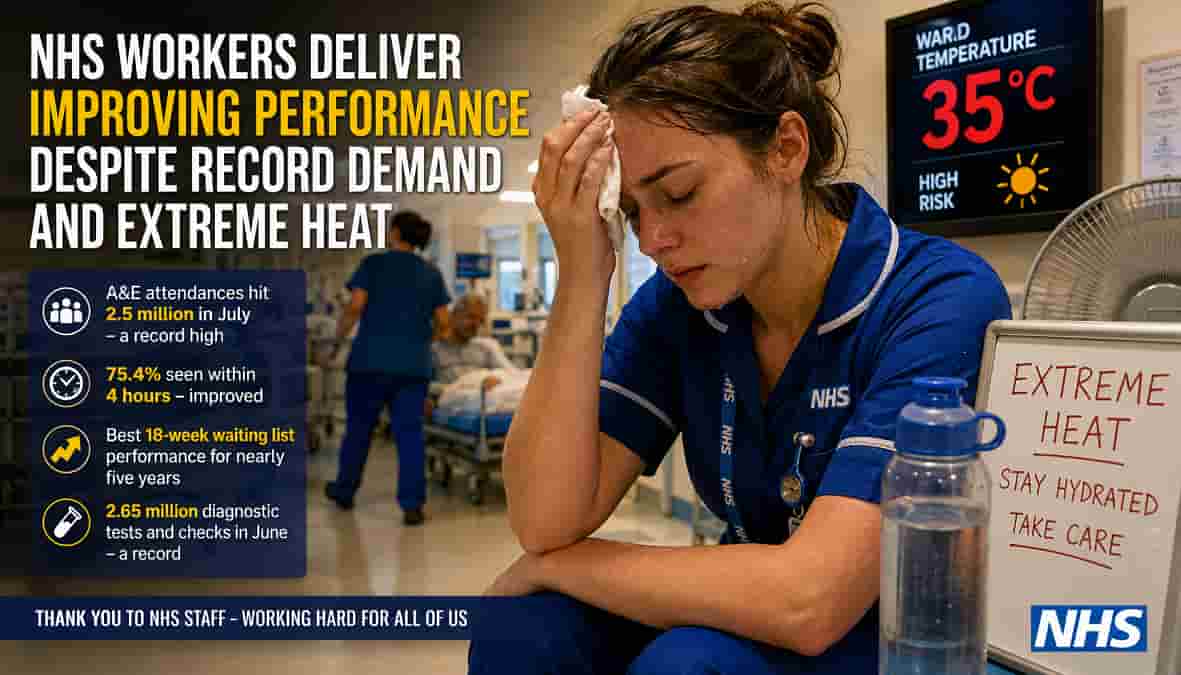
NHS workers have delivered some of the strongest improvements in hospital performance for years despite record-breaking demand and increasingly difficult working conditions caused by extreme summer temperatures.
New figures published by NHS England on 13 August show that A&E departments recorded 2.5 million attendances during July, making it the busiest July on record. May, June and July have now become the three busiest months ever recorded for emergency departments.
Yet despite unprecedented demand, NHS workers managed to improve several important measures of patient care.
Around 75.4% of patients were seen, treated, admitted or discharged within four hours, while Category 2 ambulance response times improved by two minutes and 42 seconds compared with the previous month.
The figures provide an important reminder of the contribution NHS workers continue to make while operating under considerable pressure.
Read the NHS England performance announcement
Waiting list falls as NHS workers increase activity
There was further encouraging news for patients and healthcare workers.
NHS England reported its best performance against the 18-week planned-care target for nearly five years, with 65.8% of patients waiting less than 18 weeks for treatment during June.
The overall waiting list also fell to 7.27 million, despite record numbers of patients being referred for treatment.
Meanwhile, NHS teams completed more than 2.65 million diagnostic tests and checks during June — the highest monthly number ever recorded.
Separate NHS figures also indicate that acute-sector productivity improved by 2.6% during 2025/26.
These figures do not mean the enormous pressures facing the health service have disappeared. However, they provide evidence that NHS workers are succeeding in improving important areas of performance despite exceptionally difficult circumstances.
Extreme heat creates serious workplace concerns
Behind those encouraging figures is a much more troubling workplace issue.
Reports gathered from nursing staff describe workers experiencing dizziness, nausea, exhaustion and, in some cases, collapsing while working.
Some healthcare environments have reportedly reached 35°C and above, while concerns have also been raised about keeping medicines and medical equipment within suitable operating temperatures.
The issue became particularly serious as Britain experienced its fifth heatwave of the summer.
Recent reporting has subsequently revealed even more extreme conditions, with some hospital locations recording temperatures considerably above recommended NHS levels.
Read the latest reporting on temperatures inside NHS hospitals
Workers should not have to choose between patient care and their own health
The situation raises an increasingly important workplace question.
How should hospitals and other employers protect workers when temperatures reach levels that buildings were never designed to accommodate?
Unlike some other workplace risks, UK legislation does not establish a single maximum legal working temperature. That does not remove an employer’s responsibility to manage workplace risks.
Where excessive temperatures could affect workers’ health, employers should assess the risks and consider appropriate measures.
In healthcare environments this can be particularly complicated. Workers may need to wear uniforms or personal protective equipment while carrying out physically and emotionally demanding work. Hospitals must simultaneously protect vulnerable patients, medicines and specialist equipment.
The challenge is therefore considerably greater than simply providing additional drinking water.
Ventilation, cooling systems, rest arrangements, uniforms, hydration and the design of healthcare buildings are increasingly becoming workplace issues.
Summer pressure could become the NHS’s new winter pressure
One of the most significant consequences of this summer may be a fundamental change in how the NHS prepares for seasonal demand.
Health and Social Care Secretary Yvette Cooper has said the NHS needs to begin preparing for summer pressures in the same way it currently prepares for winter pressures.
That could have important implications for NHS staffing.
Workforce planning traditionally anticipates increased demand during winter because of respiratory illness and seasonal pressures. Increasingly frequent periods of extreme heat could require hospitals to plan additional staffing, capacity, equipment and infrastructure for summer as well.
For workers, that means future NHS workforce planning may need to recognise that sustained periods of extreme heat create additional workload as well as additional workplace risks.
The Workers Union view
The latest figures deserve recognition.
NHS workers have helped deliver improving waiting-time performance, record diagnostic activity and better ambulance response times while dealing with the busiest summer emergency departments have ever experienced.
That achievement should not obscure the conditions in which some employees are working.
A hospital worker should not have to become a patient because their workplace cannot adequately manage extreme temperatures.
The Workers Union believes employers should treat excessive workplace heat as a genuine health and safety issue rather than simply an inconvenience associated with summer weather.
The encouraging performance figures demonstrate what NHS workers are capable of delivering.
The challenge now is ensuring the workplaces in which they deliver those services are equally capable of protecting them.