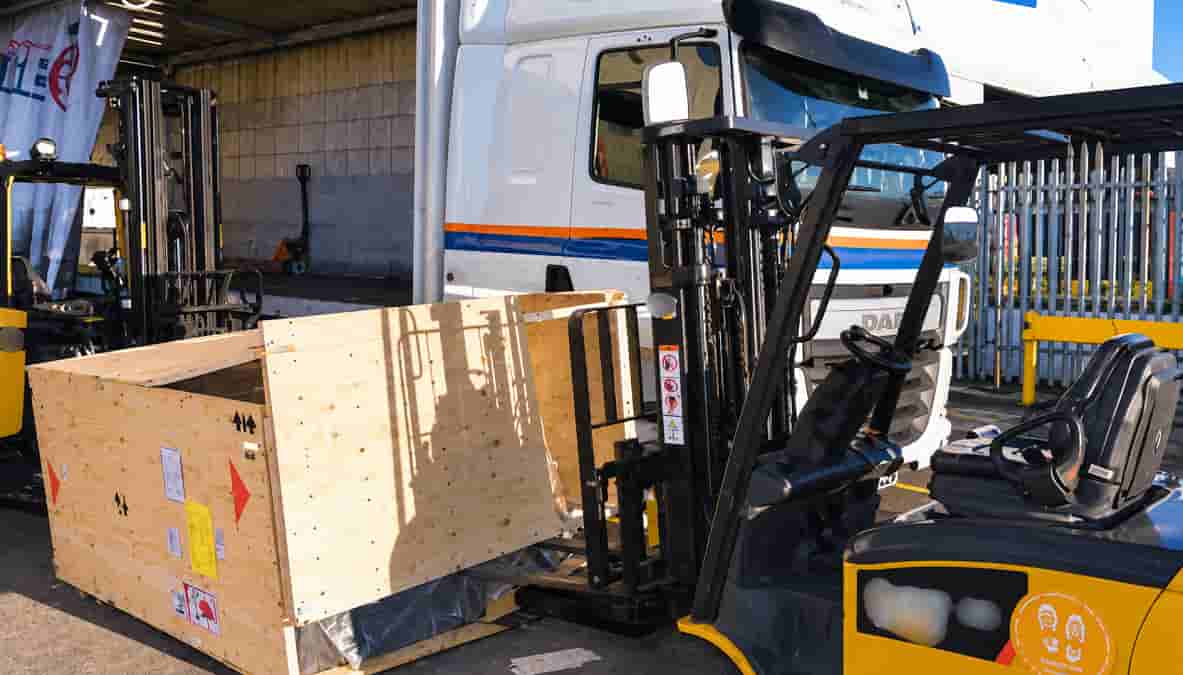
A 64-year-old worker suffered life-changing injuries after a 1.2-tonne crate fell from a forklift truck and landed on him during an unloading operation in Hull.
The incident has resulted in Smith & Nephew Medical Ltd being fined £230,000 and ordered to pay £111,000 in costs, following a prosecution brought by the Health and Safety Executive (HSE).
For UK workers involved in warehouses, factories, logistics, deliveries and materials handling, the case provides another stark reminder of what can happen when a non-standard lifting operation is not properly assessed, planned and supervised.
What happened in the Hull forklift accident?
According to the HSE investigation and prosecution details, the accident happened on 22 December 2020 when Mr Dubey, an employee of Nippon Express (UK) Ltd, delivered a large crate containing an electron microscope to Smith & Nephew Medical Ltd’s Hull site.
The crate weighed approximately 1.2 tonnes.
Nippon Express had originally intended to provide a forklift truck and driver. However, restrictions during the COVID-19 pandemic led Smith & Nephew Medical Ltd to reduce the number of people permitted on site and take responsibility for unloading the goods.
That change in arrangements was significant.
The HSE found that the task had not been properly assessed, planned or supervised. Mr Dubey was positioned unsafely and the load was lifted in an unsafe manner. The crate fell from the forklift truck and landed on him, causing life-changing injuries.
What did the HSE investigation find?
Investigators found there had been no assessment of whether the company’s two-tonne forklift was suitable when the characteristics of the 1.2-tonne load were taken into account.
The company also failed to adequately consider how the lift should be performed, who should be involved, what precautions were required and how the unloading operation should be supervised.
These findings matter to workers because the rated capacity of a forklift is only part of the safety equation.
The HSE’s guidance on safe lifting by machine makes clear that workers should not exceed safe working loads and that a load should not be lifted where there is doubt about its weight or the adequacy of the equipment. Forklifts are among the types of lifting equipment covered by the relevant lifting regulations.
Workers wanting to understand how hazards should be identified and controlled can also read The Workers Union guide to workplace risk assessments. A meaningful risk assessment should reflect the work actually being carried out, rather than existing merely as paperwork.
Company fined £230,000
Smith & Nephew Medical Ltd was found guilty of breaching Section 3(1) of the Health and Safety at Work etc. Act 1974.
The company was sentenced at Hull Crown Court on 14 September 2026, receiving a £230,000 fine and being ordered to pay £111,000 in costs.
HSE Inspector David Stewart said the company should have established clear procedures covering how deliveries would be managed and what safety measures were required for third parties attending the site.
Importantly, the regulator’s position was that those safety requirements did not disappear simply because normal delivery arrangements had changed during the pandemic.
The HSE’s wider LOLER guidance for lifting operations states that lifting operations involving lifting equipment must be properly planned by a competent person, appropriately supervised and carried out safely.
Why forklift safety matters to UK workers
Forklift trucks are part of everyday working life across Britain’s warehouses, manufacturing facilities, distribution centres and loading areas, but familiarity must not lead to complacency.
The HSE describes lift trucks as particularly dangerous and says they are involved in around a quarter of workplace transport accidents. Poor supervision and insufficient training are among the causes identified by the regulator.
The regulator’s workplace transport safety guidance also specifically says workplace transport risk assessments should consider loading and unloading activities and examine how vehicles and pedestrians move around a workplace.
That makes this latest prosecution relevant well beyond the company involved.
When working arrangements change, risk assessments should change too
One of the most important lessons from this case concerns changes to established working practices.
The Workers Union’s guidance on risk assessments at work explains that assessments should be reviewed when work processes change, new equipment is introduced, an incident occurs or workers raise concerns.
That principle has obvious relevance here.
A different company taking responsibility for unloading, a non-standard crate, unfamiliar dimensions or a change in who supervises a delivery can introduce risks that may not exist during an ordinary operation.
Employers therefore need to consider the actual task taking place on the day, including the load, equipment, environment and people involved.
What should a worker do if an unloading operation looks unsafe?
Workers should take particular care when a load is significantly larger, heavier or shaped differently from those normally handled.
Questions worth asking include whether the forklift is suitable for the specific load, whether the weight and centre of gravity are understood, whether the route and unloading area are clear, who is controlling the operation and whether pedestrians or visiting drivers could enter a dangerous area.
If something does not appear safe, workers should raise the concern before the lift proceeds.
The Workers Union’s risk assessment guidance for UK workers recommends identifying the hazard clearly, asking how the risk is being managed, documenting concerns and requesting appropriate action where necessary.
The HSE similarly advises businesses to examine where pedestrians and workplace vehicles interact and identify improvements that reduce contact between them.
The Workers Union: safety has to work in the real workplace
The financial consequences of this prosecution are substantial. But for the worker who sustained life-changing injuries, the consequences are far more personal.
For The Workers Union, the case demonstrates why workplace safety procedures must translate into practical protection for the person actually doing the job or standing near the operation.
A risk assessment cannot anticipate every event, but when circumstances change, employers should consider whether existing arrangements remain suitable.
This is particularly important around forklifts and heavy loads.
The HSE’s guidance says lifting equipment should be appropriate for its intended task and lifting operations should be properly planned, competently undertaken and appropriately supervised.
For workers, the message is equally practical: do not assume that because an operation has started, it must be safe.
If the equipment appears unsuitable, responsibilities are unclear, people are standing too close to a load, or an unusual lift appears to be taking place without sufficient planning, those concerns should be raised.
The Workers Union will continue to highlight serious workplace incidents and the lessons they provide for working people across Britain.
The objective should never simply be getting the load off the vehicle.
It should be getting the job completed without somebody being seriously injured in the process.