Thousands of British Steel workers face renewed uncertainty after MPs warned that the Government has yet to provide a sufficiently detailed plan for placing the publicly owned company on a sustainable financial footing.
British Steel was brought into public ownership in July 2026 after the Government concluded that intervention was necessary to protect domestic steelmaking, major supply chains and thousands of skilled jobs.
However, the company is reportedly costing approximately £1.3 million a day to operate. Public support could eventually reach £1.5 billion by 2028 unless a commercially sustainable production model is established.
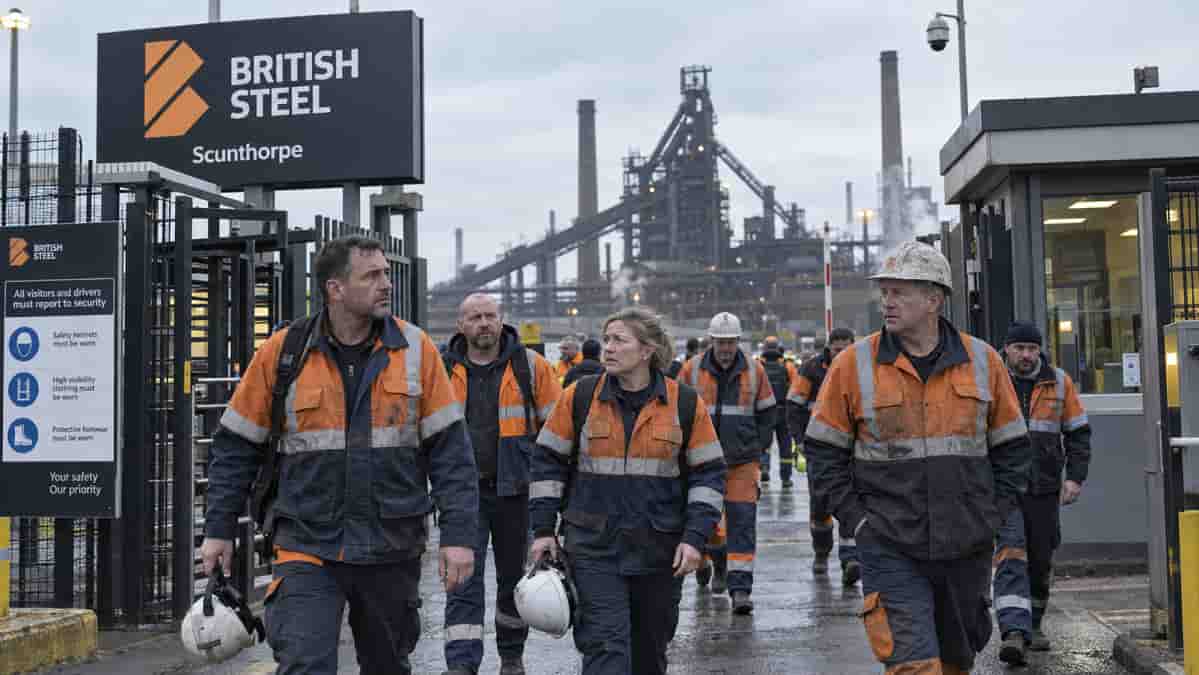
For approximately 4,000 workers connected to British Steel’s Scunthorpe operations, the debate is not simply about government accounts. It concerns job security, household incomes and the future of a town whose identity and economy have been closely connected to steelmaking for generations.
MPs demand a credible plan for British Steel
The House of Commons Public Accounts Committee has called for greater clarity over British Steel’s future business model, costs and transition towards lower-carbon production.
According to national reporting on the committee’s findings, approximately £555 million had been spent by mid-June on workers’ wages and raw materials. That figure reportedly excluded some external advisory costs.
The committee said taxpayers remain exposed to substantial and growing financial uncertainty. It wants the Government to publish a detailed plan explaining:
- British Steel’s intended production model
- how the business will become financially sustainable
- the expected cost and timetable
- the source of future funding
- the preferred route towards lower-carbon steelmaking
- the company’s long-term role within the UK economy.
The questions are significant because short-term financial support, however necessary it may be to protect production and employment, is not the same as a secure long-term industrial strategy.
Workers need to know whether investment will modernise the company, preserve specialist skills and provide sustainable employment rather than simply postpone another period of uncertainty.
Why the Government intervened
The Government brought British Steel into public ownership on 16 July 2026, following an earlier intervention in April 2025 that kept the Scunthorpe blast furnaces operating.
Ministers said public ownership was necessary to protect the national interest, domestic steel production and strategically important supply chains.
Steel is required for railways, construction, energy infrastructure, transport and defence. Losing the ability to produce it domestically could leave the UK increasingly dependent on imported material during periods of international disruption.
Government figures indicate that the wider steel industry supported around 33,000 direct jobs in 2025, together with approximately 36,000 jobs throughout associated supply chains.
The Government has also pointed to its wider steel strategy, backed by up to £2.5 billion, and an ambition for as much as half of the steel used in the UK to be produced domestically.
The argument for intervention is therefore broader than the balance sheet of one company. It involves national resilience, regional employment and whether Britain intends to maintain the skills and facilities required to produce primary steel.
Workers remain at the centre of the uncertainty
The continued operation of the Scunthorpe works has protected thousands of jobs from an immediate and potentially disorderly closure.
That intervention matters. A sudden shutdown would affect not only those directly employed at the site but also contractors, suppliers, transport providers and local businesses supported by workers’ spending.
Yet prolonged uncertainty carries its own cost.
Workers may delay major financial decisions when they are unsure about their future employment. Families can face anxiety about mortgages, rent and household bills, while highly skilled employees may begin seeking work elsewhere.
Uncertainty can also make recruitment and retention more difficult. If experienced engineers, technicians and production specialists leave, replacing their knowledge may prove challenging and expensive.
No new redundancy programme has been confirmed in the latest reports. Workers should therefore avoid treating calls for a business plan as evidence that job losses have already been decided.
However, employees should pay close attention to official workplace communications and keep copies of any correspondence concerning proposed restructuring, contractual changes or their future employment.
Workers who are formally notified that their employment may end can consult the detailed guide to termination of employment and immediate practical steps. The wider workplace help and support portal also provides information covering common employment concerns.
The difficult transition to lower-carbon steel
One of the largest questions concerns how British Steel can reduce emissions while maintaining production and protecting skilled employment.
Traditional blast furnaces produce steel from raw materials but require substantial amounts of energy and carbon-intensive fuel. Alternative technologies, including electric arc furnaces, can significantly reduce emissions but may require different processes, investment and workforce structures.
A credible transition plan must therefore consider more than equipment and environmental targets.
It should explain what will happen to workers whose existing skills are tied to traditional production, what retraining will be provided and how employment will be protected while new technology is introduced.
There is also the question of energy prices. British steelmakers have faced longstanding concerns about industrial electricity costs and their ability to compete with overseas producers operating under different market conditions.
Without addressing production costs, investment, demand and energy, changing ownership alone may not resolve the underlying commercial difficulties.
Public funding and job security must work together
The political debate is likely to focus heavily on whether taxpayers are receiving value for money. That scrutiny is necessary when public expenditure is approaching such substantial levels.
However, the value of British Steel cannot be assessed solely through its immediate profit and loss account.
The consequences of losing thousands of skilled jobs would include redundancy costs, reduced local spending, lower tax receipts and the potential loss of industrial knowledge that could take decades to rebuild. Greater reliance on imported steel could also create additional risks for infrastructure and national supply chains.
Equally, protecting jobs requires more than continuing to cover daily losses. Workers need a plan capable of securing production, customers, investment and employment over the longer term.
This means establishing measurable milestones against which progress can be assessed. These could include production volumes, new contracts, private investment, energy-efficiency improvements, workforce retention and the timetable for modernising the Scunthorpe site.
What British Steel workers need next
British Steel workers need clear and regular information about the company’s financial position, production plans and proposed transition.
The Workers Union believes that employees whose skills have sustained a strategically important national industry must remain central to decisions about its future.
A sustainable settlement should aim to protect skilled employment, provide retraining where technology changes roles and give workers enough certainty to plan their lives.
Public ownership has prevented an immediate collapse, but it was the beginning of the process rather than its conclusion. The next test is whether the Government and British Steel’s leadership can turn emergency intervention into a viable industrial future.
For the workers entering the Scunthorpe site each day, the need for that plan is becoming increasingly urgent.