
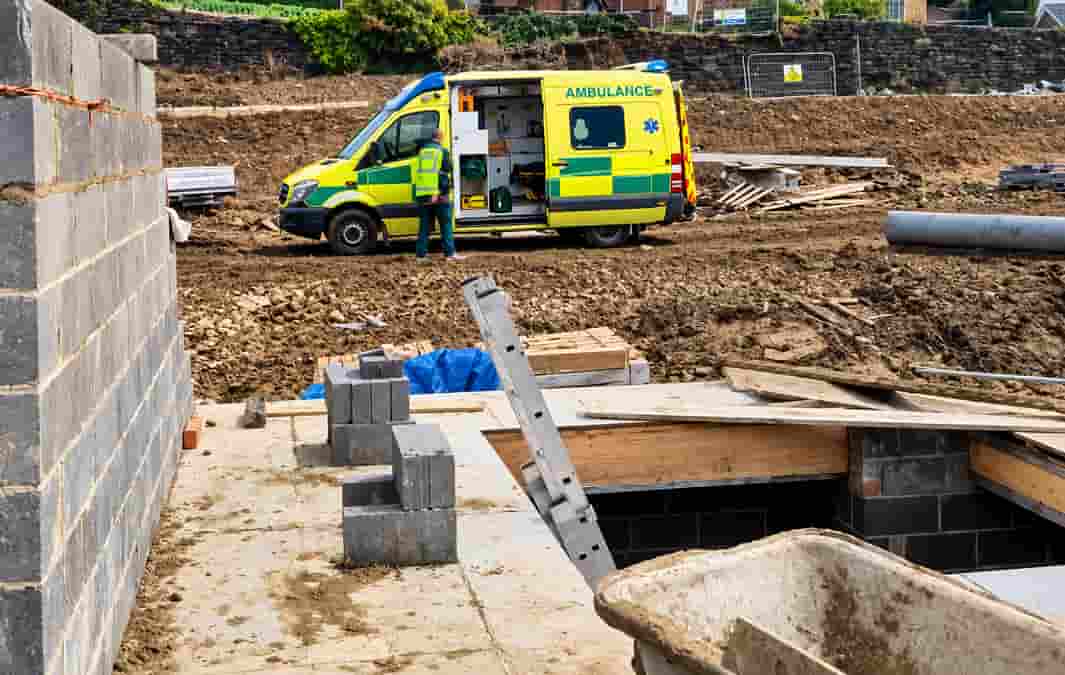
A 24-year-old father suffered serious spinal injuries after falling through an unprotected stairwell opening at a construction site, in another workplace accident highlighting the potentially life-changing consequences of inadequate protection from falls.
Joseph Tuck was working as a temporary labourer for a scaffolding company when he fell one storey through an opening intended for a staircase and landed on the concrete floor below.
It was only his second week on the job.
The accident, which happened during January 2024 at a development of four new homes in Sowerby Bridge, West Yorkshire, resulted in injuries serious enough to prevent Mr Tuck from working for several months.
He has not returned to a physical job since.
For workers across the construction industry, the case is another stark reminder that an unprotected opening, missing guardrail or unsecured covering can change someone’s working life in seconds.
Worker fell unconscious after plunging through stairwell
Mr Tuck was working on a housing development being constructed by Hillbeck Homes (Sowerby Bridge) Ltd.
The staircase had not yet been installed, leaving an opening between floors.
According to the Health and Safety Executive, the opening had previously been covered using loose scaffold boards, but those boards had been removed.
The opening was therefore not securely covered and its exposed edges had not been protected when the accident occurred.
Mr Tuck stepped backwards and fell through the opening onto the concrete below.
He was knocked unconscious.
West Yorkshire Fire & Rescue Service and a Hazardous Area Response Team were required to rescue him because there was no alternative means of accessing the sub-floor where he had fallen.
The consequences have extended far beyond the day of the accident.
Serious spinal injuries prevented Mr Tuck from working for months, and the HSE says he has not subsequently been able to return to physical employment.
HSE identifies multiple failures
An investigation by the Health and Safety Executive found that Hillbeck Homes (Sowerby Bridge) Ltd had failed to put adequate measures in place to prevent workers falling from height.
According to the regulator, the company failed to properly plan and appropriately supervise the work at height and failed to take suitable and sufficient measures to prevent a fall.
The danger presented by the stairwell was neither unusual nor difficult to understand.
HSE said simple measures such as properly securing the scaffold boards covering the opening or installing suitable edge protection could have prevented Mr Tuck’s fall.
HSE Inspector Louise Redgrove described the accident as “wholly avoidable” and attributed it to basic failures in planning and supervision.
The case reinforces a message The Workers Union has repeatedly highlighted: health and safety controls need to be in place before a worker is exposed to danger, rather than introduced after somebody has been seriously injured.
The Workers Union recently reported another case involving a 24-year-old bricklayer who broke his back after falling through a fragile roof. In that incident, HSE similarly identified failures to properly assess and control work at height.
Construction company fined £300,000
Hillbeck Homes (Sowerby Bridge) Ltd was found guilty of three health and safety charges relating to the management of work at height.
At Leeds Magistrates’ Court on 16 September 2026, the company was fined £300,000 and ordered to pay £9,284.05 in costs.
The financial penalty is substantial, but for the injured worker the consequences are much more personal.
Mr Tuck was 24, a father and only two weeks into the job when the accident occurred. He suffered injuries that prevented him working for months and has not been able to return to physical employment.
For somebody whose working life might otherwise have involved decades of physically demanding employment, that represents a potentially profound change to future career prospects, income and independence.
Falls from height remain a major cause of workplace deaths
Despite decades of safety legislation and established guidance, falls from height remain one of the most serious hazards facing British workers.
HSE says falls from height account for around a quarter of fatal injuries to workers each year in the construction industry.
The risks are not confined to scaffolding or workers operating many metres above ground.
Open stairwells, floor openings, fragile roofs, ladders, unprotected edges and relatively short drops onto hard surfaces can all cause fatal or life-changing injuries.
The Workers Union highlighted precisely this problem following the case of bricklayer Nicholas Crow, who suffered life-changing injuries after falling around 2.6 metres through an unguarded opening at a Warwickshire building site.
Mr Crow suffered severe head injuries and a stroke and was left with substantial long-term disabilities.
Different sites and different workers, but the underlying safety lesson is strikingly similar: an exposed opening capable of causing a serious fall must be effectively controlled before workers are allowed into the area.
What should employers do when workers could fall through an opening?
The Work at Height Regulations require work at height to be properly planned, appropriately supervised and carried out safely.
Where there is a risk of somebody falling through a floor, roof, stairwell or working platform, HSE guidance points towards physical safeguards such as appropriate coverings, guardrails and scaffolding, alongside suitable planning and task-specific risk assessment.
HSE guidance on working safely at height
The priority should be preventing the fall rather than relying solely on measures designed to reduce the consequences once someone has fallen.
For an opening such as an unfinished stairwell, this means considering whether access can be prevented, whether the opening can be securely covered or whether suitable edge protection is required.
A loose covering that can be moved or removed may cease to provide protection.
That appears particularly relevant in this case because HSE established that loose scaffold boards had previously covered the stairwell but had been removed before Mr Tuck’s accident.
Temporary workers deserve the same protection
Another important feature of the case is Mr Tuck’s employment circumstances.
He was working as a temporary labourer for a scaffolding company and had been on the job for only two weeks.
New, temporary and inexperienced workers can be particularly dependent on employers and those controlling construction sites to ensure hazards are identified and safe systems are clearly communicated.
Being temporary does not make a worker’s safety temporary.
Employers and those responsible for workplaces must ensure that workers are not exposed to avoidable risks simply because they are new to a site, unfamiliar with its layout or employed through another organisation.
The Workers Union provides further information for workers through our health and safety at work guidance, including support for members who are concerned about unsafe workplace practices.
Workers should not have to discover hazards through injury
Construction sites change constantly.
Floor openings appear as buildings progress, scaffolding is altered, access routes change and protective equipment may be moved as different stages of work are completed.
That makes effective supervision particularly important.
A safeguard that was present yesterday cannot simply be assumed to remain in place today.
Those responsible for managing a site should ensure that changing conditions are assessed and that workers are not allowed into areas where essential fall protection has been removed.
HSE’s findings in the Sowerby Bridge case demonstrate how serious the consequences can become when that process fails.
The human cost extends beyond the courtroom
Health and safety prosecutions inevitably produce figures: fines, costs and sentencing dates.
But those numbers can obscure the most important consequence.
A young worker went to work and came away with serious spinal injuries.
Mr Tuck was just 24 years old and a father. He had been working at the site for only two weeks. His injuries stopped him working for months and have prevented him returning to physical employment.
For workers who earn their living through construction, manufacturing, engineering and other physically demanding occupations, an injury that removes the ability to perform manual work can fundamentally alter a career.
It can also affect family life, financial security and future employment choices long after a prosecution has concluded.
The Workers Union view
Jonathan Morgan, spokesperson for The Workers Union said “every worker should be able to go to work with the reasonable expectation that basic and foreseeable dangers have been properly controlled.
An unfinished stairwell on a construction site presents an obvious risk.
Preventing someone falling through it does not require experimental technology or an unknown safety solution. As the HSE made clear following this prosecution, straightforward measures such as securing the covering or installing edge protection could have prevented this accident.
That is what makes cases such as this particularly troubling.”
The Workers Union has previously reported serious injuries involving unguarded openings on building sites and fragile roofs where appropriate precautions had not been put in place.
These incidents should not become accepted as an unavoidable feature of construction work.
Falls from height are a known danger. The methods for controlling that danger are also well known.
The responsibility is to make sure those measures are actually in place before somebody falls.
Workers who have concerns about unsafe conditions should raise them promptly through the appropriate workplace procedures. Members of The Workers Union who need support with a workplace health and safety concern can also access help through our member services.
The Workers Union help and support
For employers, contractors and workers seeking detailed technical information, the HSE provides specific guidance covering the planning and management of work at height.