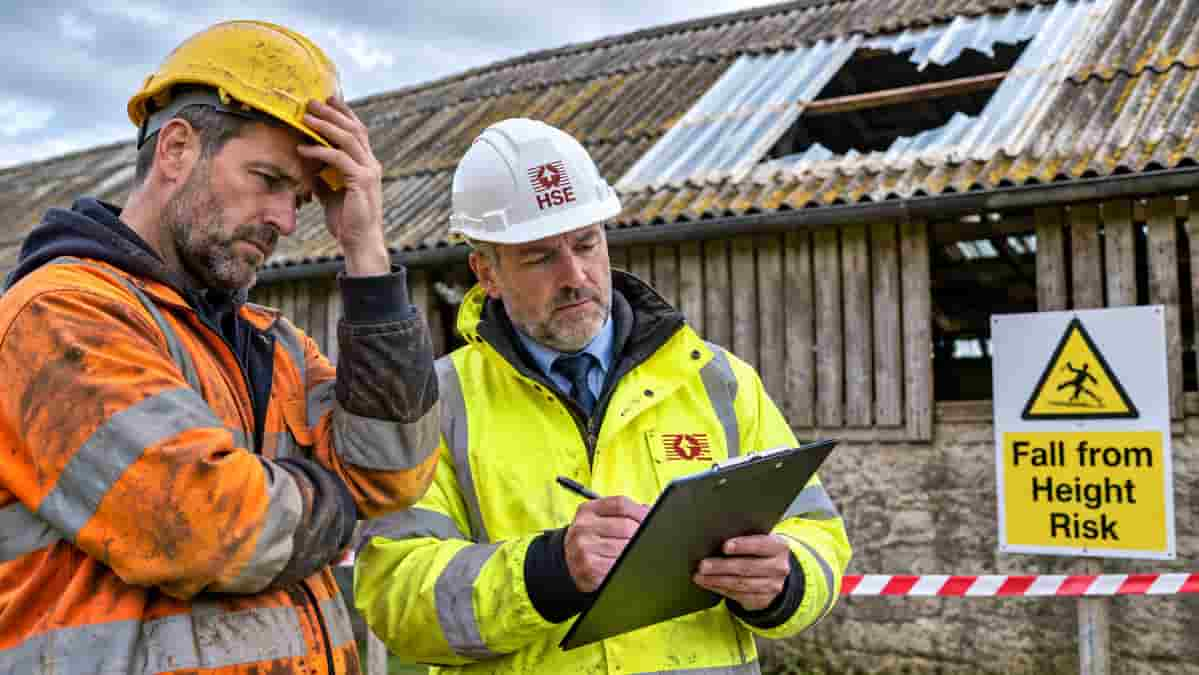
A Lancashire construction and landscaping company has been fined £20,000 after a 47-year-old worker suffered multiple serious fractures when he plunged approximately 33 feet through a fragile barn roof, in another preventable workplace accident that highlights the dangers facing British construction workers.
Josh Huddleston was employed by AJ Riley Landscapes and Building Limited when he was instructed to replace a damaged skylight at Marl House Farm in Abbeystead, Lancashire, on 24 February 2025.
What should have been a routine maintenance task resulted in a devastating fall of approximately 10 metres, leaving Mr Huddleston with fractures to his ribs, vertebrae and pelvis.
An investigation by the Health and Safety Executive (HSE) subsequently uncovered significant shortcomings in the company’s safety arrangements, including inadequate planning, insufficient training and ineffective precautions to prevent workers falling through fragile roofing materials.
The prosecution, concluded earlier this month, was also highlighted in specialist workplace safety publications on 20 November.
HSE investigation exposes workplace safety failures
According to the official HSE prosecution report, the company had identified safety measures within its risk assessment but had not provided sufficient training to ensure workers could use them competently.
At Warrington Magistrates’ Court on 3 November 2026, AJ Riley Landscapes and Building Limited, based in Caton, Lancashire, admitted breaching Section 2(1) of the Health and Safety at Work etc. Act 1974.
The company received a £20,000 fine and was ordered to pay £4,955 in prosecution costs.
Following the hearing, HSE inspector Matthew Shepherd said: “It is fortunate that Mr Huddleston survived this fall, which could easily have resulted in fatal injuries.”
The inspector emphasised that established safety precautions could have prevented the incident and warned employers of their responsibilities when undertaking work at height. The case raises an important question for construction employers: what purpose does a risk assessment serve if the precautions it identifies are not effectively implemented?
A document alone cannot prevent a worker from falling through a roof. Physical protection, appropriate equipment, competent supervision and effective training must accompany it.
Another serious construction injury in a worrying series of roof falls
The Workers Union has repeatedly highlighted the devastating consequences of inadequate protection for employees working at height.
In August 2026, our article, Bricklayer breaks back in yet another preventable fall from height, reported how a 24-year-old construction worker suffered spinal and chest injuries after falling through a fragile barn roof in Northumberland. The employer in that case was also fined £20,000.
In June, we reported how an experienced Manchester joiner was left paralysed following a construction site fall. Adam Kirkpatrick, 53, sustained a severe spinal cord injury after falling through an inadequately secured roof opening. His injuries permanently changed his life and affected his family’s retirement plans.
Further coverage in September revealed how a young father was unable to return to physical work following a devastating construction site fall. In that case, Hillbeck Homes (Sowerby Bridge) Ltd was fined £300,000 following an incident involving an unprotected stairwell opening.
These incidents occurred at different locations and involved different employers. Nevertheless, they share a recurring feature: workers were exposed to foreseeable dangers without adequate protection.
Why fragile roofs remain a serious danger to UK workers
One of the most concerning aspects of accidents involving fragile roofs is that the risks are already widely understood. Older roofing sheets, skylights, translucent panels and deteriorating building materials may appear capable of supporting a person’s weight when, in reality, they cannot.
According to the HSE’s publication, Health and safety in roof work, roof work accounts for approximately a quarter of construction industry deaths.
The regulator also highlights that those exposed to these dangers are not exclusively professional roofers. Maintenance workers, surveyors and other employees required to access roofs are equally vulnerable.
This is particularly relevant to smaller construction businesses, agricultural contractors, property maintenance companies and self-employed workers who may undertake occasional roof repairs. The fact that a task is relatively straightforward or expected to take only a short period does not justify reducing safety precautions.
What employers must do to prevent falls from height
Under the Work at Height Regulations 2005, employers and those controlling work at height must ensure suitable precautions are taken to protect workers.
Before roof repairs or maintenance begin, employers should:
- Establish whether the work can safely be completed without accessing the roof.
- Identify fragile roofing materials, skylights and other potential hazards.
- Provide appropriate working platforms, edge protection, safety netting or other suitable fall protection.
- Ensure employees receive adequate instruction and practical training.
- Provide effective supervision throughout the work.
- Establish appropriate emergency and rescue arrangements.
- Review working conditions when weather or other circumstances introduce additional risks.
Employers should never assume that previous experience alone makes a worker sufficiently protected. Further information is available through the HSE’s official guidance on working at height.
The human cost of workplace injuries
While the financial penalty imposed on AJ Riley Landscapes and Building Limited amounts to £24,955, including prosecution costs, the consequences of serious workplace injuries cannot be measured solely in financial terms.
Multiple spinal, pelvic and rib fractures can require extensive medical treatment, rehabilitation and prolonged periods away from employment.
For workers engaged in physically demanding occupations, serious injuries can also threaten future earning potential, career progression and financial independence. Families may experience additional pressures associated with caring responsibilities, reduced household income and uncertainty over recovery.
The HSE’s published account does not establish Mr Huddleston’s current medical condition or whether he has returned to employment. However, the severity of his reported injuries demonstrates how quickly an ordinary working day can become a medical emergency.
Workers have the right to raise safety concerns
Construction workers who believe they are being asked to undertake dangerous activities without sufficient protection should raise their concerns immediately.
Under applicable employment legislation, workers have protections against certain detrimental treatment where they take appropriate action in circumstances of serious and imminent danger.
The Employment Rights Act 1996, Section 44 provides important protections in qualifying circumstances. Workers can also report workplace health and safety concerns directly to the HSE.
Further workplace information and support are available through our dedicated construction workers’ help and support page. No employee should feel compelled to place their personal safety at risk simply to complete a task, meet a deadline or protect their employment.
Preventable workplace accidents must not become accepted practice
The prosecution of AJ Riley Landscapes and Building Limited serves as another reminder that employers must translate their legal responsibilities into practical workplace protection.
Britain’s construction industry depends on skilled, experienced and hardworking individuals. Protecting those workers should be fundamental to every project, regardless of its size, duration or financial value.
The industry does not need to wait for another serious injury to understand the dangers associated with fragile roofing materials. The risks are established, protective equipment is available and safety guidance already exists.
What is required is consistent implementation.
Every British worker deserves to return home safely at the end of their working day. A damaged skylight can be replaced. A worker’s health, independence and ability to earn a living may never be fully restored.
Workplace safety must begin before the job starts, not after somebody has been seriously injured.