Millions of commuters face the prospect of renewed travel disruption across London as Underground drivers prepare to begin a series of eight 24-hour strikes following the breakdown of talks over proposed changes to working conditions and shift patterns.
The first walkout will begin tomorrow midday on Thursday, 26 November 2026, with disruption expected to continue until Friday evening.
Last-minute discussions held through the Advisory, Conciliation and Arbitration Service (Acas) on Tuesday failed to secure an agreement, leaving passengers, businesses and workers facing considerable uncertainty in the run-up to Christmas and into February 2027.
Why are London Underground drivers going on strike?
At the centre of the dispute are proposed changes to working arrangements, including the introduction of a voluntary four-day working week for Underground drivers. While a shorter working week may appear attractive, drivers involved in the dispute have raised concerns about the conditions attached to the proposals.
These include longer duties, increased driving time, changes to shift arrangements, annual leave provisions and potential reductions in staffing. Transport for London (TfL), however, maintains that its revised proposals would give drivers greater flexibility and reduce the overall time they spend at work each year.
Management has also introduced an option allowing drivers to retain a five-day working pattern under revised employment conditions, with a guarantee that they can remain at their existing depot.
The dispute therefore extends beyond the number of days worked. It concerns how those hours are organised, the protection of existing employment conditions and the potential consequences for job security.
London Underground strike dates: November 2026 to February 2027
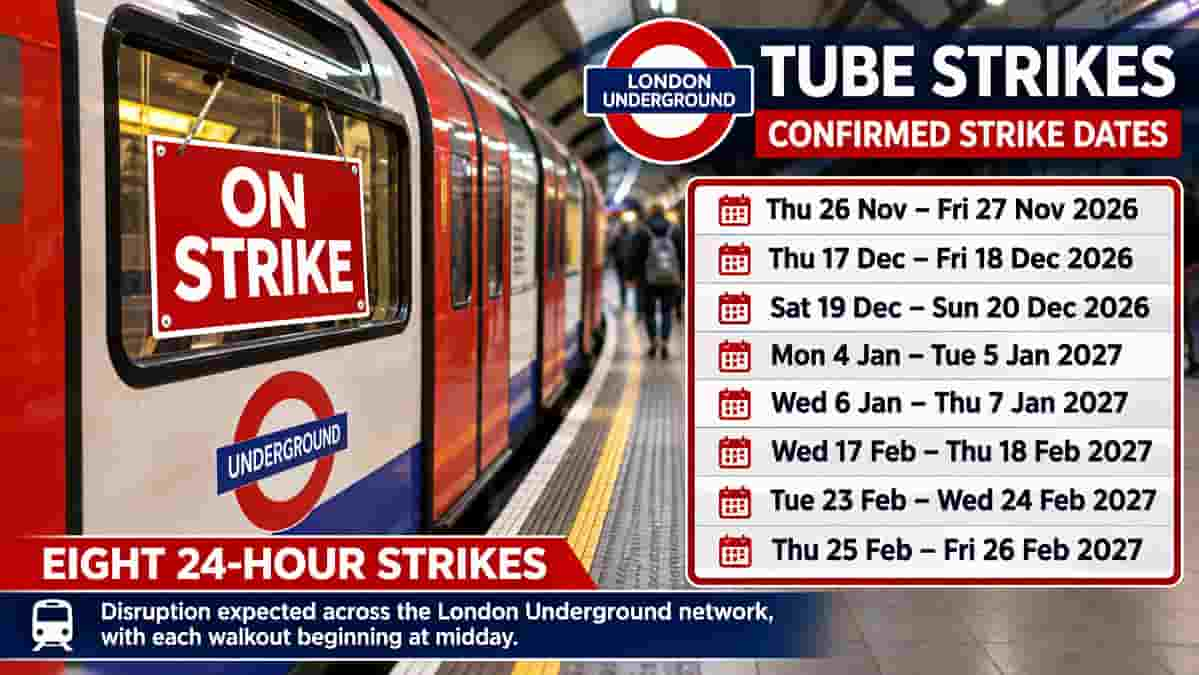
Eight separate periods of industrial action are currently scheduled.
| Strike begins | Strike ends |
| Thursday 26 November | Friday 27 November 2026 |
| Thursday 17 December | Friday 18 December 2026 |
| Saturday 19 December | Sunday 20 December 2026 |
| Monday 4 January | Tuesday 5 January 2027 |
| Wednesday 6 January | Thursday 7 January 2027 |
| Wednesday 17 February | Thursday 18 February 2027 |
| Tuesday 23 February | Wednesday 24 February 2027 |
| Thursday 25 February | Friday 26 February 2027 |
Each scheduled walkout begins at midday and lasts approximately 24 hours, although travel disruption may extend beyond these periods. The dates remain subject to change if an agreement is reached.
Passengers can monitor developments through the official TfL strike information page.
Which London Underground lines will be affected?
TfL has warned that disruption is expected across the entire Underground network during this week’s industrial action. On Thursday, the Circle and Piccadilly lines are expected to have no service throughout the day. Waterloo & City line services are expected to cease at midday.
Other Underground services will operate at reduced levels, with disruption beginning from approximately 10am. On Friday, services are expected to resume gradually from around 7am, with normal operations anticipated by approximately 6pm.
The Elizabeth line, London Overground, DLR, buses and trams are expected to continue operating, although passengers should anticipate increased demand. Further information is available through National Rail’s industrial action update.
Christmas strikes could place additional pressure on British workers
The timing of the planned December walkouts is particularly concerning for employees working in retail, hospitality, healthcare, security and other sectors where working from home is rarely an option. The strikes scheduled for 17 and 19 December fall during one of the busiest trading periods of the year.
For hourly paid employees, transport disruption can mean lost earnings, additional commuting expenses and difficulties meeting childcare commitments. Small businesses may also experience staffing shortages, reduced customer numbers and operational difficulties during a commercially important period.
While Underground drivers have legitimate concerns about their working arrangements, the consequences of industrial action extend considerably beyond the transport industry. Ordinary working people should not become the unintended casualties of an unresolved workplace dispute.
Can employers deduct pay if workers are late because of Tube strikes?
Employees should be aware that there is generally no automatic statutory entitlement to payment for working time missed because of public transport disruption. However, employment contracts, workplace policies and individual arrangements may provide additional protections.
Workers affected by the Underground strikes should contact their employer as early as possible to discuss alternative arrangements, including flexible start times, temporary homeworking, adjusted shifts or annual leave.
Employers should also recognise that not every employee has access to alternative transport or can afford additional commuting expenses.
Further information is available through our workplace help and support services.
A reasonable and understanding approach from employers could prevent unnecessary workplace disputes during the forthcoming disruption.
Four-day working week: improvement or increased pressure?
The Underground dispute raises a wider question about the future of working arrangements across Britain. A four-day working week can potentially deliver significant benefits, including improved work-life balance, reduced commuting costs and greater employee satisfaction.
However, compressing working hours into fewer days is different from genuinely reducing working hours.
In safety-critical industries such as public transport, fatigue management must remain a fundamental consideration.
TfL maintains that its proposed working patterns have been assessed using industry-standard fatigue management tools and disputes suggestions that the arrangements would increase driver fatigue. Drivers involved in the dispute remain concerned about the practical implications of the proposed changes.
The Office of Rail and Road’s guidance on managing rail staff fatigue provides important information about managing these risks. Any modernisation of Britain’s transport network must balance operational efficiency with employee wellbeing and passenger safety.
Communication, negotiation and resolution must come first
The Workers Union maintains that constructive dialogue, meaningful negotiation and a fast practical resolution should remain central to resolving workplace disputes. Employers must listen to genuine concerns about working conditions, job security and employee welfare. Equally, the wider consequences of prolonged industrial action on other working people must not be overlooked.
With eight walkouts scheduled over the coming months, there remains an opportunity for further discussions to prevent additional disruption. London Underground employees deserve fair working conditions, manageable shift patterns and confidence in their employment security.
Britain’s commuters also deserve a reliable and affordable transport network that enables them to earn a living without unnecessary financial hardship.
Protecting the interests of one group of workers should not come at the expense of another. A sustainable resolution must work for transport employees, passengers, businesses and the wider British workforce.