The first weeks of 2026 have delivered a stark warning to the nation’s main shopping districts. What began as a steady stream of closures in recent years has now become a torrent, testing the resilience of businesses and placing thousands of UK workers under mounting strain. As the Workers Union team continues to track these developments, the reality is undeniably sobering: the country is bracing for one of the most bruising years the retail sector has faced in over a decade.
Several well-known brands have confirmed sweeping shutdowns, contributing to a rapidly changing high-street landscape. This shift has been driven by rising operational costs, evolving consumer behaviour and substantial tax changes. Among the most disruptive pressures is the increased National Insurance contribution that took effect last April. Experts estimate that this change alone will remove more than £2.3 billion from retail operations over the coming year, a financial weight that many firms simply cannot carry.
The impact is not merely financial—it is deeply human. Last year saw almost 17,500 shop closures and the loss of more than 200,000 roles. Many organisations warn that the combined effects of increased employment costs and reduced margins are intensifying at a faster pace than anticipated, creating difficult choices for employers and further uncertainty for workers.
Major closures across the UK
The latest wave of announcements illustrates the scale of the challenge:
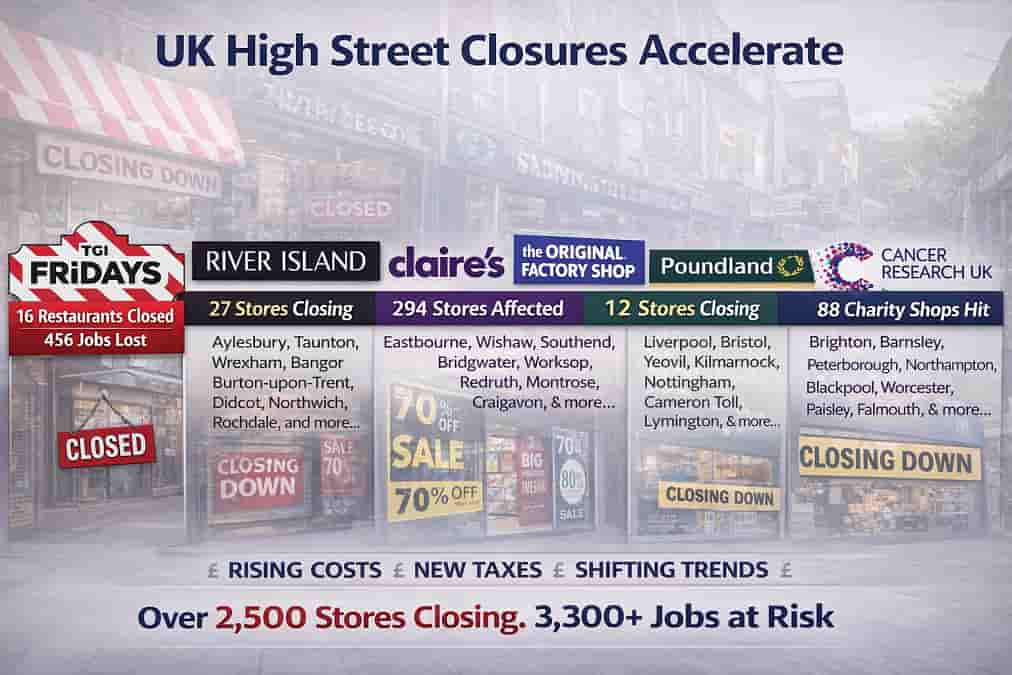
TGI Friday’s – 456 jobs lost
The American-style restaurant chain closed 16 venues on 13 January following its UK entity entering administration. Although 33 sites continue to trade, hundreds of staff in locations including Coventry, Nottingham, Aberdeen Beach and Stratford have been affected. Administrators have already transferred the remaining business to a new owner, but the closures represent a significant blow to hospitality workers at TGI Fridays for the start of the year.
River Island – up to 33 stores closing
The fashion retailer has embarked on a major restructuring, with more than 10% of its store base disappearing this month. Sites from Perth to Wrexham and Beckton to Barnstaple are preparing to shut their doors. The organisation insists the move is necessary to build long-term stability, but the loss of so many local retail roles will be acutely felt.
Claire’s and The Original Factory Shop – 294 stores affected
With both brands entering administration on 5 January, around 2,500 workers now face an uncertain path. Weak seasonal trading and rising costs have been cited as key pressures. The closures affect workers across towns that rely heavily on steady year-round footfall.
Poundland – 12 closures in January alone
After a troubled period culminating in a £1 sale in 2025, the chain continues to shrink its portfolio. Sites from Bristol to Liverpool and Edinburgh’s Cameron Toll are closing as part of its ongoing restructuring review.
Cancer Research UK – 88 shops to disappear by May 2026
Even charitable organisations, traditionally dependent on lower overheads, are experiencing severe strain. The planned closures place around 600 staff and thousands of volunteers in a difficult position, though the charity intends to consolidate and develop a smaller number of larger stores.
The impact on UK workers
The challenges faced by workers are intensifying as the year progresses. Forbes Burton’s latest analysis suggests that more than 120,000 roles have been lost or placed at risk due to company failures and restructuring in the last year alone. Rising wage obligations, combined with reduced margins for discount chains and charity organisations, have made survival far more difficult.
For thousands of employees, the question is no longer about long-term career growth—it is about immediate stability. The Workers Union continues to emphasise that workers must stay informed, seek expert guidance early and remain aware of their rights during periods of organisational change. As closures continue at pace, protecting livelihoods remains paramount.
If early figures are any indication, 2026 may be the year the UK high street changes beyond recognition. The coming months will test large and small businesses alike, and for workers across the country, the focus is rightly fixed on security, fairness and clear communication during an increasingly turbulent period.