
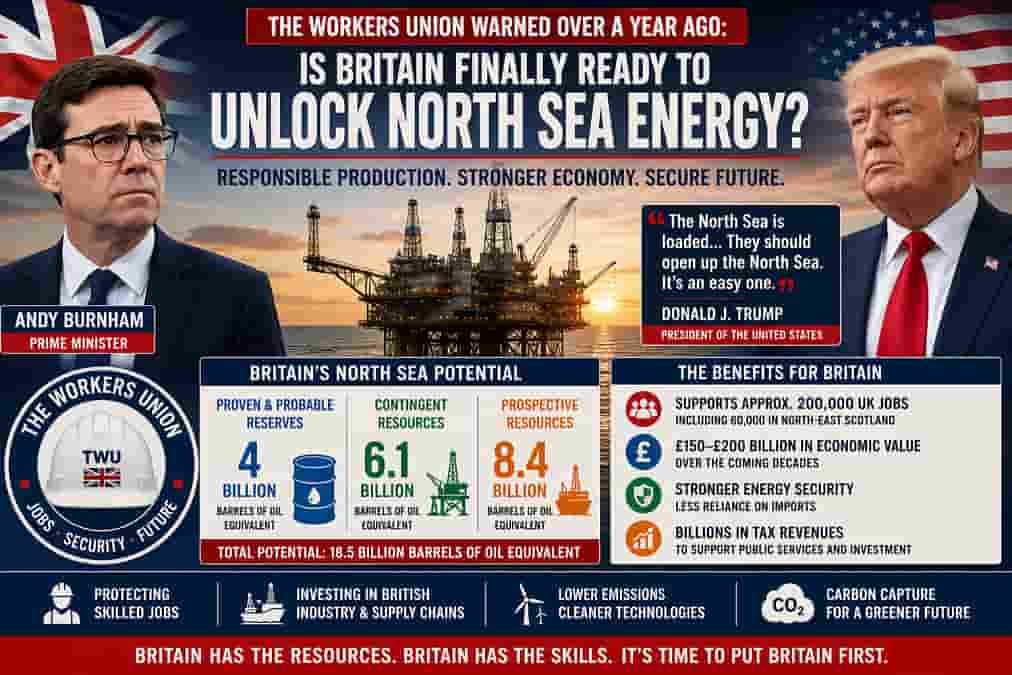
For more than a year, The Workers Union has been asking a question that is now dominating political debate across Britain and beyond.
Should the United Kingdom continue importing expensive energy from overseas while sitting on billions of barrels of oil and gas beneath the North Sea?
That question has taken on fresh significance after United States President Donald J. Trump publicly urged Prime Minister Andy Burnham to open up Britain’s offshore energy reserves, arguing that the UK is overlooking one of its greatest economic assets.
President Trump said:
“The North Sea is loaded… They should open up the North Sea. It’s an easy one.”
Whether one agrees with the President or not, his comments have reignited a debate that affects millions of workers, thousands of businesses and the long-term future of the British economy.
The Workers Union first explored this issue well over a year ago, highlighting the potential economic benefits of responsibly developing Britain’s remaining natural resources, creating jobs for workers and providing a much needed cash injection while continuing the transition towards cleaner energy.
Today, that conversation has become more relevant than ever.
Britain is sitting on a vast energy opportunity
Despite decades of production, the UK’s North Sea still contains substantial untapped reserves.
According to the latest figures from the North Sea Transition Authority (NSTA):
- Around 4 billion barrels of oil equivalent remain in proven and probable reserves.
- A further 6.1 billion barrels of oil equivalent have already been discovered but remain undeveloped.
- Industry estimates suggest another 8.4 billion barrels of prospective resources lie close to existing offshore infrastructure.
Collectively, these resources could continue supplying Britain with domestically produced energy for decades while reducing reliance on increasingly expensive imported fuel.
At a time when energy prices continue to influence household budgets and business costs, domestic production has become an issue extending far beyond the offshore industry.
Jobs that Britain cannot afford to lose
Behind every offshore platform is an extensive supply chain supporting communities throughout the United Kingdom.
The offshore oil and gas sector currently supports approximately 200,000 jobs, including around 60,000 workers across north-east Scotland, with thousands more employed in engineering, manufacturing, logistics, transport, fabrication, marine services and specialist technology throughout England, Wales and Northern Ireland.
These are highly skilled, well-paid careers that have helped build Britain’s industrial capability for generations.
Expanding responsible exploration and developing existing discoveries could help preserve these jobs while creating thousands of additional opportunities in construction, maintenance, engineering design and advanced manufacturing.
For many workers, this is not simply an energy debate.
It is a jobs debate.
The economic case remains compelling
North Sea production has already delivered billions of pounds to the Treasury.
During periods of elevated energy prices, government revenues from offshore production reached around £9 billion in a single year through taxation and the Energy Profits Levy.
Industry analysis suggests responsible development of remaining reserves could:
- Generate £150–£200 billion of economic value over the coming decades.
- Support tens of thousands of skilled UK jobs.
- Reduce Britain’s dependence on imported oil and liquefied natural gas.
- Improve national energy resilience during periods of global instability.
- Generate billions in additional tax revenues that could support public services and infrastructure.
Britain also continues to spend billions importing energy from overseas despite possessing significant domestic resources.
That reality has become increasingly difficult to ignore.
Learning from Norway
President Trump also highlighted the comparison many economists have made for years.
Norway has used North Sea revenues to build one of the world’s largest sovereign wealth funds, now valued at well over £1.5 trillion, providing long-term financial security for future generations.
Successive UK governments chose a different approach, with much of Britain’s North Sea energy income being absorbed into general public spending rather than creating a comparable national investment fund.
As political discussion returns to domestic energy production, many are asking whether Britain missed an historic opportunity—and whether there is still time to maximise the value of its remaining resources.
Climate responsibility remains essential
The UK remains committed to achieving net zero, and renewable energy continues to play an increasingly important role within the national energy mix.
This should not be viewed as a choice between renewables and responsible domestic production.
Carbon Capture, Usage and Storage (CCUS), lower-emission offshore developments, improved operational efficiency and continued investment in wind, hydrogen and nuclear technologies can all contribute towards a balanced energy strategy.
Developing Britain’s remaining North Sea resources while accelerating cleaner technologies does not have to be mutually exclusive.
The Workers Union Says..
“More than a year ago, The Workers Union highlighted the importance of having an honest discussion about Britain’s own energy resources. Today that discussion has moved firmly into the political mainstream.
“Workers want secure employment, affordable energy and long-term investment in British industry. The question should never be about choosing between today’s jobs and tomorrow’s technologies. Britain has the skills, engineering expertise and innovation to support both.
“If responsible North Sea development can strengthen energy security, reduce dependence on imports and protect thousands of skilled jobs while continuing investment in lower-carbon technologies, then that is a debate based on evidence rather than ideology.
“British workers deserve an energy policy that protects livelihoods, supports economic growth and gives future generations confidence that the UK is making the most of its own resources.”
A debate whose time has arrived
The conversation surrounding Britain’s energy future has changed dramatically.
What was once a discussion led primarily by industry experts is now being debated by world leaders, economists and governments.
Whether Prime Minister Andy Burnham ultimately decides to expand North Sea production or pursue an alternative course, the decisions taken over the coming months will have lasting consequences for workers, businesses and communities across the United Kingdom.
The Workers Union believes that any long-term energy strategy must place brilliant UK workers at its heart—protecting skilled employment, strengthening energy security and ensuring Britain remains competitive while continuing its transition towards a lower-carbon future.
As this debate gathers pace, one thing has become increasingly clear.
Britain’s greatest untapped resource may not simply be the oil and gas beneath the North Sea—it is the skilled workforce ready to deliver the country’s next chapter.