
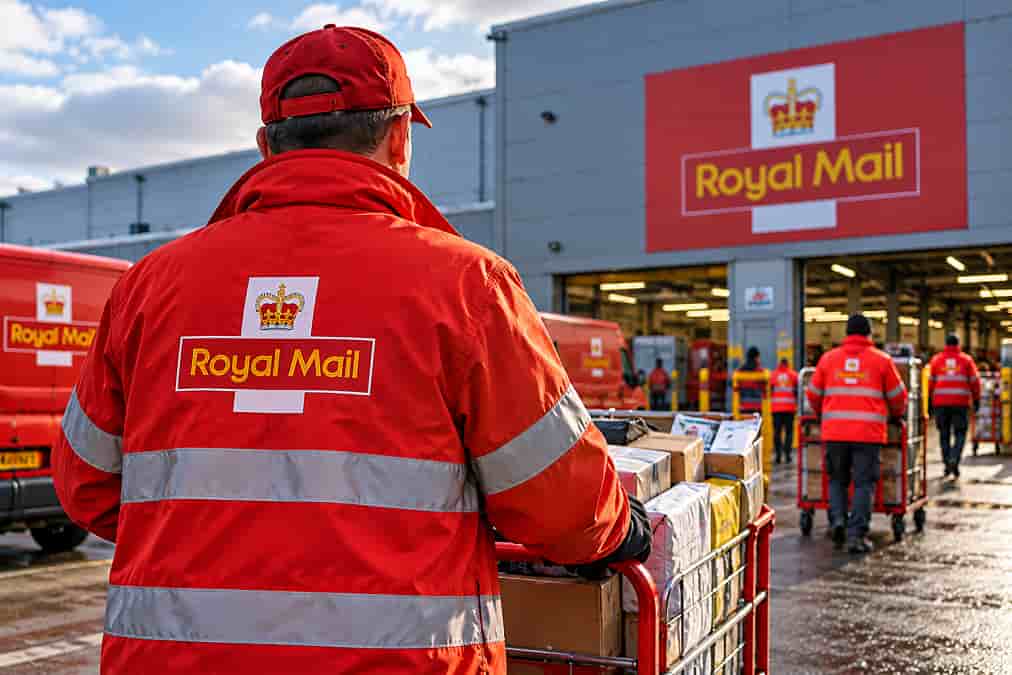
Up to 2,500 Royal Mail workers could lose their jobs as Britain’s postal giant announces a major restructuring programme, despite simultaneously recruiting around 22,000 temporary employees for the Christmas period.
The proposed job reductions, announced on 7 October 2026, will primarily affect head-office, management and support functions as Royal Mail attempts to reduce costs, simplify its operations and respond to significant changes in the postal industry.
The company says the reductions will take place by the end of 2027 and are expected to be achieved through natural attrition and voluntary redundancy arrangements.
Frontline postal workers, delivery drivers and employees involved in processing mail are not included in the announced reductions.
Nevertheless, the scale of the proposals represents another significant employment development at one of Britain’s most recognisable employers.
And with Royal Mail employing more than 131,000 people, the announcement raises important questions about the future of postal employment, job security and the changing nature of Britain’s delivery industry.
2,500 jobs at risk as Royal Mail restructures
Royal Mail says the proposed reductions form part of an organisational review designed to create a simpler and more efficient business.
The company is seeking to remove duplicated responsibilities, streamline decision-making and reduce administrative costs.
According to Reuters’ report on the restructuring, the proposals affect fewer than 2% of Royal Mail’s total workforce.
However, that percentage should not obscure the human impact.
For the individuals whose positions are affected, the announcement could mean uncertainty over their future employment, income and career prospects.
Chief executive Alistair Cochrane said the proposed changes would help remove duplication and allow the business to invest more in improving customer services.
The company has confirmed that formal consultation is underway.
No final outcome should be assumed while that process continues.
Will posties and delivery drivers lose their jobs?
One of the most important aspects of the announcement is the distinction between support functions and frontline operations.
Royal Mail says its proposed reductions will not affect operational frontline roles in delivery and processing, including postal workers and drivers.
The company also expects to avoid compulsory redundancies under the current proposals.
That is an important reassurance for thousands of employees who deliver letters and parcels across the country.
However, it does not eliminate the uncertainty facing workers in management, administration and support functions.
According to Sky News’ coverage of the announcement, the proposals include positions at Royal Mail’s London head office and within other support operations.
The company is undertaking the changes in stages, with further organisational reviews expected.
For workers, the distinction between a role being excluded from the current announcement and being permanently protected from future restructuring is important.
The present proposals do not amount to a guarantee that no further changes will ever take place.
Why is Royal Mail cutting jobs?
Royal Mail is facing a profound change in how Britain communicates and sends goods.
Traditional letter volumes have fallen by more than 70% from their historic peak.
Households and businesses increasingly rely on email, electronic billing, online banking and digital correspondence.
At the same time, online shopping has created substantial demand for parcel deliveries.
But the parcel market is highly competitive.
Royal Mail now competes with specialist delivery companies and other logistics operators, many of which have different operating structures and employment models.
The business is therefore attempting to adapt an established nationwide postal network to a market in which letters are declining and parcels are becoming increasingly important.
Royal Mail is also implementing changes to the Universal Service framework, which governs aspects of the postal service provided throughout the United Kingdom.
The communications regulator Ofcom oversees the postal sector and the performance of the universal postal service.
For workers, these developments raise a wider concern.
As the postal industry changes, what will happen to the employees whose careers have been built around its traditional structure?
22,000 Christmas jobs offer a contrasting picture
Perhaps the most striking feature of the announcement is its timing.
While Royal Mail prepares to reduce thousands of permanent support positions, it is also recruiting around 22,000 temporary workers to help manage the Christmas delivery period.
The recruitment drive includes seasonal opportunities in sorting offices, delivery operations, logistics and driving.
Applicants can explore available vacancies through the company’s official Royal Mail careers website.
This creates an unusual employment picture.
One part of the business is preparing to become smaller.
Another requires a substantial temporary workforce to meet seasonal demand.
The apparent contradiction reflects the different pressures affecting modern logistics businesses.
Christmas produces an enormous increase in parcel volumes, creating a short-term requirement for additional workers.
That does not necessarily translate into permanent employment in head-office, management or administrative functions.
Nevertheless, the contrast will not be lost on employees facing potential redundancy.
Thousands of jobs could disappear from one part of Royal Mail while thousands of new workers are recruited elsewhere.
Are seasonal jobs a sign of recovery?
Royal Mail’s Christmas recruitment is welcome news for people looking for work, particularly those seeking temporary employment, additional income or an opportunity to enter the logistics industry.
However, seasonal recruitment should not automatically be interpreted as evidence of sustained employment growth.
Temporary Christmas positions and permanent year-round jobs serve different purposes.
A seasonal contract may provide valuable income and experience, but it may also end shortly after the busiest trading period.
This distinction is especially important against the backdrop of a challenging wider employment market.
In our recent report, UK job vacancies fall for 34th month as workers face a tough employment market, we examined how declining vacancies have increased competition among jobseekers.
Royal Mail’s announcement illustrates how employment opportunities and redundancy risks can exist simultaneously, even within the same organisation.
Other major employers are also increasing seasonal recruitment.
For example, our recent article on Currys hiring 1,000 Christmas workers highlighted how temporary employment can sometimes provide a route into permanent work.
But there is no guarantee that seasonal positions will become permanent.
Workers considering Christmas employment should therefore check the duration of their contracts, expected hours, pay arrangements and any realistic opportunities for longer-term employment.
Postal workers face an uncertain future
Royal Mail’s restructuring follows several difficult years for the business.
The company has faced criticism over delivery performance, increasing operating costs and the challenges associated with maintaining a nationwide postal service.
The business is also adjusting to its new ownership following the acquisition of its parent company by EP Group, controlled by Czech businessman Daniel Křetínský.
The takeover was completed in 2025.
Royal Mail remains a major employer with a distinctive place in British working life.
Its employees provide an essential service connecting homes, businesses, hospitals and communities.
That makes changes to the organisation particularly significant.
For many workers, employment at Royal Mail has traditionally been associated with established career paths and long-term service.
The latest proposals demonstrate that even longstanding national institutions are not immune from restructuring.
What happens to workers facing redundancy?
Royal Mail has said the proposed job reductions are expected to take place through voluntary departures and natural attrition.
Natural attrition generally means reducing workforce numbers when employees leave and their positions are not replaced.
Voluntary redundancy involves employees being offered the opportunity to leave under an agreed redundancy arrangement.
However, workers should not assume that every voluntary redundancy package will necessarily be suitable for their circumstances.
Important considerations can include redundancy payments, pension implications, notice arrangements, accrued holiday entitlement and the availability of alternative employment.
Employees should also establish whether accepting a voluntary redundancy package affects any contractual benefits or other entitlements.
Where employers propose significant job reductions, consultation requirements may apply.
Workers can find further information in our redundancy rights UK guide.
The Government also provides official guidance covering redundancy rights and statutory redundancy pay.
Understanding the difference between statutory entitlements and an employer’s enhanced redundancy arrangements can be particularly important.
Could workers move into other Royal Mail roles?
One question affected employees may reasonably ask is whether alternative positions will be available within the organisation.
Royal Mail operates a substantial network of delivery offices, sorting centres, logistics facilities and support operations.
However, the availability of vacancies does not automatically mean that every affected employee can transfer into another role.
Different positions may require different skills, working patterns, locations and contractual arrangements.
Where suitable alternative employment exists, the employer’s legal obligations and any applicable redundancy procedures will need to be considered.
Employees should seek clarity about whether redeployment opportunities are available, how vacancies will be advertised and whether any training or transitional support will be provided.
For some workers, redeployment could provide a route to continued employment.
For others, the proposed restructuring may mean considering opportunities outside the organisation.
The wider challenge facing Britain’s postal industry
Royal Mail’s announcement is not simply a story about one employer reducing its administrative workforce.
It reflects wider structural changes affecting British employment.
Digital technology has reduced demand for traditional postal services.
Online shopping has created new delivery requirements.
Automation is changing sorting and logistics operations.
Competition is influencing costs, staffing structures and working practices.
These changes can create opportunities in some occupations while reducing demand in others.
The challenge for employers is to manage that transition without treating experienced workers as disposable.
Employees who have contributed years of service should receive appropriate consultation, clear information and fair consideration of their future options.
At the same time, Britain’s postal and delivery infrastructure must remain capable of providing reliable services to households and businesses.
Job security must remain part of the conversation
The Workers Union believes that employment developments of this scale should be examined not only through the financial savings they may deliver, but also through their consequences for the people affected.
Royal Mail’s stated intention to avoid compulsory redundancies is welcome.
So too is the continued demand for seasonal workers.
But neither removes the anxiety that a restructuring announcement can create for employees whose positions may disappear.
Workers need clarity about the timetable, the roles affected, consultation arrangements and the support available.
They also need reassurance that decisions will be made fairly and communicated properly.
A changing Royal Mail — but at what cost to workers?
Royal Mail has served British households and businesses for centuries.
Its distinctive red vans, postal workers and delivery network remain familiar features of everyday life.
But the business is changing.
Fewer letters, more parcels, greater competition and increasing pressure to control costs are reshaping its workforce.
The proposed loss of up to 2,500 jobs is another significant sign of that transformation.
For those applying for one of the company’s thousands of Christmas vacancies, Royal Mail may represent a welcome employment opportunity.
For employees in head-office and support functions, the same organisation may now represent uncertainty.
That contrast captures a wider reality of Britain’s changing employment market.
New jobs are being created, but established jobs are also disappearing — sometimes within the very same company.
The real measure of Royal Mail’s restructuring will not simply be whether the business becomes more efficient.
It will also be how fairly it treats the workers whose livelihoods are affected.
Because behind every proposed job reduction is a person, a household and a future that deserves careful consideration.