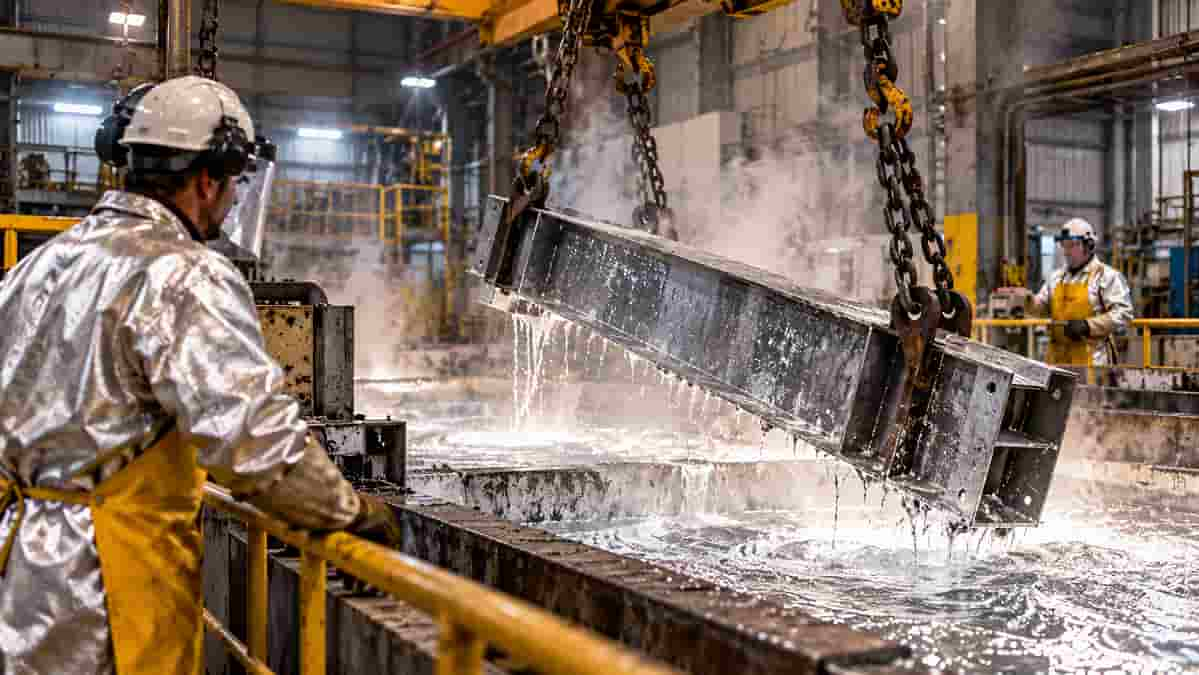
An industrial worker suffered life-changing injuries when a three-tonne steel beam plunged into molten zinc, sending burning metal across a factory floor. A Health and Safety Executive investigation uncovered damaged lifting chains, missed inspections and unsafe lifting arrangements.
A major British steel galvanising company has been fined £566,666 after an employee suffered devastating burns covering 40% of his body in an industrial accident involving molten metal.
Wedge Group Galvanizing Limited was prosecuted following an incident at its facility in Crediton, Devon, where a steel beam weighing almost three tonnes fell into a bath of molten zinc.
The impact sent a wave of extremely hot metal across the factory floor, engulfing a 33-year-old employee who was working nearby.
According to the Health and Safety Executive’s official prosecution announcement, published on 20 October 2026, the worker suffered extensive burns, required emergency hospital treatment and underwent 13 separate operations.
He spent 11 days in intensive care and subsequently experienced serious complications, including infection and sepsis, leaving him with multiple long-term health conditions.
The prosecution raises important questions about industrial safety standards, employers’ responsibilities and the potentially catastrophic consequences of failing to inspect lifting equipment properly.
Three-tonne steel beam plunges into molten zinc
The accident occurred on 12 October 2021 at Wedge Group Galvanizing’s facility on the Lords Meadow Industrial Estate in Crediton.
The company specialises in hot-dip galvanising, an industrial process in which steel components are immersed in molten zinc to protect them against corrosion.
During the operation, workers were using lifting equipment to move a heavy steel beam weighing almost three tonnes.
However, a lifting chain failed, causing the beam to fall into the galvanising bath.
The impact displaced a large quantity of molten zinc, creating a wave that struck the employee.
The hot metal then hit a wall before flowing back across the floor towards him.
CCTV footage examined during the investigation showed the injured worker running towards an emergency shower while his clothing was burning.
Colleagues removed his clothing and he was doused with water before paramedics provided emergency treatment.
He was subsequently transported by air ambulance to Southmead Hospital in Bristol.
The severity of his injuries required extensive skin grafting and prolonged medical care.
For workers employed in manufacturing, engineering, steel processing and heavy industry, the circumstances demonstrate how quickly an equipment failure can become a life-threatening emergency.
HSE investigation uncovers damaged chains and missed safety inspections
The Health and Safety Executive launched an investigation into the circumstances surrounding the accident.
Investigators identified several serious failures involving the lifting equipment and the way the operation had been organised.
The chains used to lift the steel beam showed signs of damage and deterioration but had not been withdrawn from use.
Crucially, they had also not undergone the mandatory regular examinations required for lifting accessories.
The investigation found that the arrangement used to secure and lift the beam was incorrect.
As a result, the load placed on the chains exceeded their safe working capacity.
The risk assessment covering the operation also failed to specify the necessary chain checks or the correct lifting configuration.
These findings demonstrate that the incident was not simply the result of an unexpected mechanical failure.
It involved deficiencies in equipment inspection, lifting arrangements and the assessment of foreseeable risks.
Company fined more than half a million pounds
Wedge Group Galvanizing Limited, whose registered address is in Willenhall, West Midlands, pleaded guilty to breaching Section 3(1) of the Health and Safety at Work etc. Act 1974.
At Bristol Magistrates’ Court on 14 October 2026, the company was fined £566,666 and ordered to pay £15,521 in prosecution costs.
COURT PENALTY
£582,187
£566,666 fine plus £15,521 costs
HSE inspector Alexander Ashen described the accident as wholly avoidable and criticised the company’s inadequate inspection arrangements.
He said the consequences could have been even worse and expressed concern that an established industrial business had failed to implement adequate safeguards.
The prosecution reinforces the importance of complying with workplace safety legislation, particularly where employees are exposed to heavy loads, dangerous machinery and extremely high temperatures.
Lifting equipment must be inspected and maintained
The case highlights the requirements of the Lifting Operations and Lifting Equipment Regulations 1998, commonly known as LOLER.
Under these regulations, employers must ensure that lifting operations are properly planned, appropriately supervised and carried out safely.
Lifting accessories, including chains and slings, must generally undergo thorough examination by a competent person at least every six months, unless an appropriate examination scheme specifies otherwise.
Equipment must also be suitable for the task, and defects that could create danger must be addressed.
The HSE’s official guide to lifting equipment at work explains employers’ responsibilities for inspections, examination schemes, safe lifting and record-keeping.
In galvanising operations, lifting chains may be exposed to particularly demanding conditions.
The HSE reported that relevant industry guidance and the chain manufacturer’s instructions called for daily pre-use inspections in the acidic environments associated with galvanising.
The failure to identify deterioration and withdraw unsuitable equipment was therefore a central issue in this prosecution.
Previous workplace accidents highlight repeated lifting safety failures
This latest prosecution follows several serious industrial accidents previously reported by The Workers Union.
In September, our article 1.2-tonne crate falls from forklift leaving worker with life-changing injuries examined a case involving Smith & Nephew Medical Limited.
A 64-year-old worker suffered life-changing injuries when a heavy crate fell from a forklift truck during an unloading operation in Hull.
The company was fined £230,000 and ordered to pay £111,000 in costs.
Although the circumstances differed from the Devon galvanising accident, both cases involved serious injuries associated with moving heavy industrial loads.
Another recent case involved a manufacturing worker who lost part of his thumb when a heavy stainless-steel structure slipped during fabrication.
Our report, Worker loses part of thumb days after near-identical workplace accident, highlighted how a previous, similar incident had occurred at the same company only days earlier.
That case demonstrated the importance of investigating near misses and responding promptly when warning signs emerge.
Taken together, these incidents underline the dangers associated with lifting, moving and positioning heavy materials when suitable equipment, safe working methods and effective supervision are absent.
Molten metal presents additional dangers to industrial workers
Industrial workers involved in steel production, casting, foundries and galvanising face hazards beyond those associated with ordinary materials handling.
Molten metal can cause catastrophic burns, while equipment failures may create secondary dangers through splashing, falling objects and uncontrolled movement.
The HSE maintains dedicated safety guidance for the molten metals industry, covering lifting operations, protective clothing, equipment hazards and occupational health risks.
The regulator also publishes molten metal safety alerts, including warnings about the dangers of water contamination in certain molten-metal processes.
Employers must consider the particular hazards of each operation and ensure that suitable engineering controls, safe systems of work, training and emergency arrangements are in place.
Personal protective equipment is important, but it cannot replace the need to prevent dangerous incidents from occurring.
Workers who are uncertain whether their employer has supplied suitable protective equipment can consult our workplace help and safety guidance for further information.
What should workers do if lifting equipment appears unsafe?
Employees working with cranes, lifting chains, forklifts, hoists and other heavy machinery should be able to raise safety concerns without being placed under pressure to ignore obvious risks.
Warning signs may include visible damage to lifting accessories, missing inspection records, unsuitable equipment, unclear lifting procedures or loads that appear to exceed the equipment’s rated capacity.
Where an employee believes that an operation presents a serious danger, the concern should be reported promptly to the appropriate supervisor or safety manager.
The equipment should not be used until the concern has been properly assessed and resolved.
Workers can also refer to the HSE’s guidance on planning and organising lifting operations, which explains the importance of competent planning and appropriate supervision.
Where serious safety concerns remain unresolved, employees may be able to report them to the relevant enforcing authority.
The HSE provides information on raising workplace health and safety concerns.
Employees may also have statutory protections in circumstances involving serious and imminent danger, although the application of those rights depends on the facts of the individual case.
The lasting consequences of workplace injuries
Behind the financial penalty is the experience of an employee whose life was fundamentally changed.
The injured worker was just 33 when the accident occurred.
He subsequently endured extensive hospital treatment, repeated surgery, serious complications and long-term health problems.
Such injuries can have consequences extending far beyond the immediate accident.
Recovery may involve further medical treatment, rehabilitation, psychological support and adjustments to everyday activities.
Employees can also face uncertainty about their future ability to work and earn a living.
For families, serious workplace injuries may create additional financial and emotional pressures.
This is why workplace safety must be treated as an essential part of responsible business operations rather than simply a regulatory obligation.
Industrial safety must remain a priority
The £566,666 fine imposed on Wedge Group Galvanizing Limited is a significant reminder of the consequences of failing to maintain safe lifting equipment and procedures.
The HSE investigation identified damaged chains, missed examinations, incorrect lifting arrangements and shortcomings in the risk assessment.
These were identifiable risks associated with an industrial operation involving heavy steel components and molten metal.
The case also demonstrates why inspections, competent supervision and effective safety procedures must be maintained consistently.
For workers across Britain’s manufacturing, engineering, construction and industrial sectors, the message is clear: no production deadline or operational pressure should take precedence over preventing serious injury.
Every employee deserves to return home safely at the end of their working day.