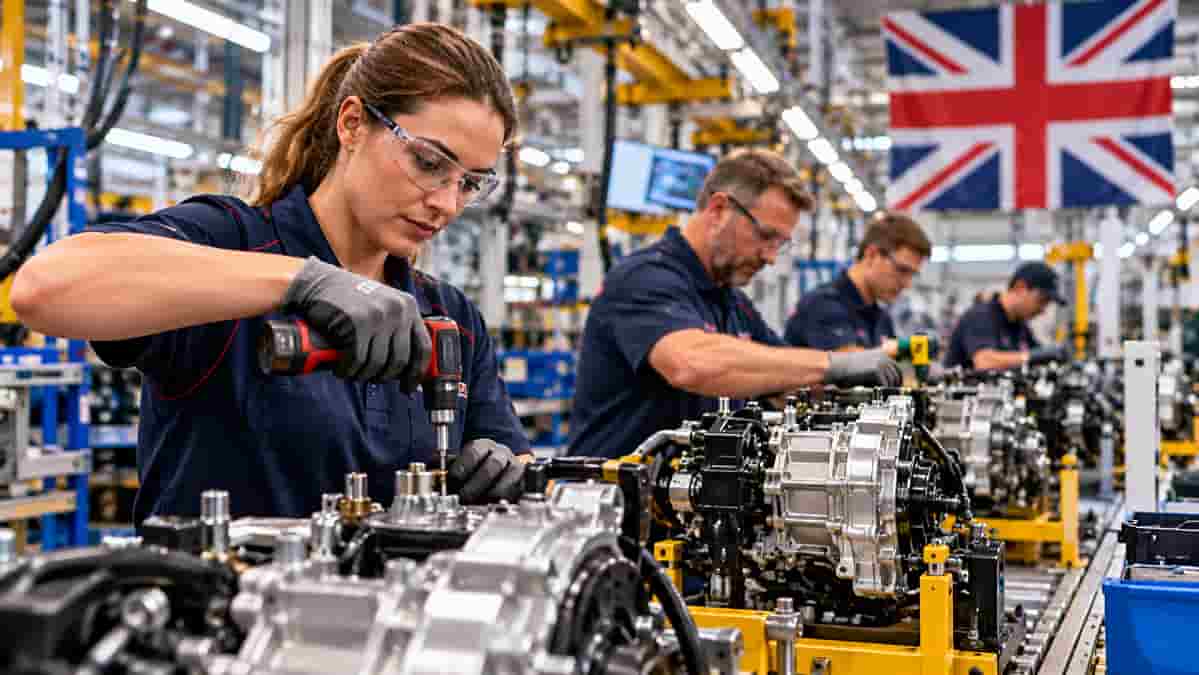
Britain’s economy has delivered an unexpected boost, with manufacturing output climbing, pharmaceutical production accelerating and technology helping drive growth. The latest figures offer renewed hope for UK workers after months of uncertainty over recruitment, redundancies and business confidence.
Britain’s economy has delivered a welcome surprise, expanding faster than economists expected as a sharp increase in manufacturing output helped strengthen hopes of a sustained economic recovery.
Fresh figures released by the Office for National Statistics (ONS) on Thursday 15 October reveal that the UK economy grew by 0.1% in August 2026, defying forecasts of a 0.1% contraction.
More encouragingly, manufacturing output increased by 1.2% during the month, providing a significant contribution to Britain’s economic performance.
The latest figures also show that GDP was 2.1% higher than in August 2025, the strongest annual monthly comparison since 2022.
For millions of UK employees, particularly those working in manufacturing, engineering, pharmaceuticals and technology, the figures offer cautious optimism that parts of the economy are beginning to strengthen.
Manufacturing leads Britain’s economic recovery
Manufacturing was one of the standout performers in August, with nine of the sector’s 13 subsectors reporting increased output.
The most significant improvement came from pharmaceutical manufacturing, which recorded growth of 5.1%.
Transport equipment manufacturing also expanded by 1.8%, providing further encouragement for industries supporting vehicle production, engineering and industrial supply chains.
The figures suggest that Britain’s industrial base retains considerable potential despite the financial pressures businesses have faced in recent years.
UK economic performance — August 2026
Monthly GDP growth
+0.1%
Manufacturing output
+1.2%
Pharmaceutical manufacturing
+5.1%
Transport equipment
+1.8%
Source: ONS monthly GDP and Index of Production releases, 15 October 2026. Figures represent changes from July to August 2026.
The performance is especially relevant to industrial regions across the Midlands, North West, Yorkshire and other parts of the country where manufacturing remains an important source of employment.
However, the recovery is not universal. Food, beverage and tobacco manufacturing output declined by 1.0%, demonstrating that some industries continue to face difficult trading conditions.
Technology and artificial intelligence help drive growth
Another encouraging development is the contribution being made by Britain’s technology sector.
The ONS identified computer programming, consultancy and related activities as the largest individual industry contributor to economic growth over the three months to August when compared with the same period last year.
Scientific research and development, legal services and information-related activities also made substantial contributions.
The growing importance of artificial intelligence, software development and digital services presents potential opportunities for workers seeking to develop new skills or move into emerging occupations.
While concerns remain about automation replacing certain roles, the latest figures demonstrate that technological investment can also contribute positively to economic output.
For workers, the challenge will be ensuring that expanding industries create accessible employment opportunities and provide the training necessary to help people adapt.
Eight consecutive periods of three-month economic growth
Perhaps the most encouraging aspect of the latest announcement is that Britain’s recovery extends beyond one month’s performance.
The economy expanded by 0.7% in the three months to August compared with the preceding three months.
According to the ONS, this marks the eighth consecutive period of growth on this rolling three-month measure.
Services output increased by 0.9% over the same period, while manufacturing recorded modest growth of 0.1%.
These figures suggest that the economy is demonstrating resilience despite continuing pressures from business costs, international uncertainty and uneven consumer demand.
Nevertheless, construction remains an area of concern.
Construction output declined by 0.2% in August and by 1.0% over the three-month period, highlighting the uneven nature of Britain’s recovery.
Could stronger economic growth lead to more UK jobs?
For workers, the most important question is whether stronger economic performance will translate into greater job security, increased recruitment and improved wages.
Recent recruitment surveys have already suggested that permanent hiring is beginning to recover after an extended period of weakness.
However, some employers remain cautious about creating new positions, particularly where operating costs and uncertainty about future demand continue to affect investment decisions.
The latest manufacturing figures provide a reason for optimism, especially for workers with skills in engineering, production, electronics, pharmaceuticals and industrial maintenance.
If businesses experience sustained growth in demand, they may eventually require additional employees, specialist contractors and support services.
There may also be opportunities for apprentices and younger workers seeking careers in industries with longer-term growth potential.
But economic growth does not guarantee an immediate increase in employment. Businesses can increase production through improved productivity, investment in equipment and more efficient operations without necessarily expanding their workforce.
For employees seeking better opportunities, the coming months will provide an important test of whether Britain’s economic improvement translates into tangible benefits.
What does the recovery mean for wages and living standards?
Stronger economic performance can create more favourable conditions for wage growth, particularly where employers compete to attract experienced and skilled employees.
Manufacturing, engineering and technology businesses may face greater demand for specialist expertise if the recovery continues.
This could benefit workers seeking career progression or opportunities to negotiate improved employment terms.
However, household living standards also depend on inflation, taxation, housing costs and the availability of secure employment.
Workers may welcome improving economic headlines while still experiencing financial pressures in their everyday lives.
The Workers Union believes that a meaningful economic recovery should ultimately benefit the people whose skills, dedication and productivity make business growth possible.
Employees looking for information about workplace rights, employment contracts and pay concerns can access further guidance through our workplace help and support pages.
A welcome improvement, but challenges remain
The latest figures provide genuine encouragement for Britain’s economy.
Manufacturing has delivered a strong monthly performance, technology continues to contribute to growth, and overall economic output has exceeded expectations.
Yet the recovery remains uneven.
Construction activity has weakened, some manufacturing industries are struggling, and employers continue to approach recruitment cautiously.
The next important test will be whether improving output encourages businesses to invest in their workforce and create sustainable employment opportunities.
For Britain’s workers, the hope is that stronger economic performance will eventually deliver more vacancies, better career prospects and improved financial security.
The encouraging message from today’s figures is that Britain’s economy is moving forward. The challenge now is ensuring that the recovery reaches the factory floor, the workplace and the household budgets of ordinary working people.