
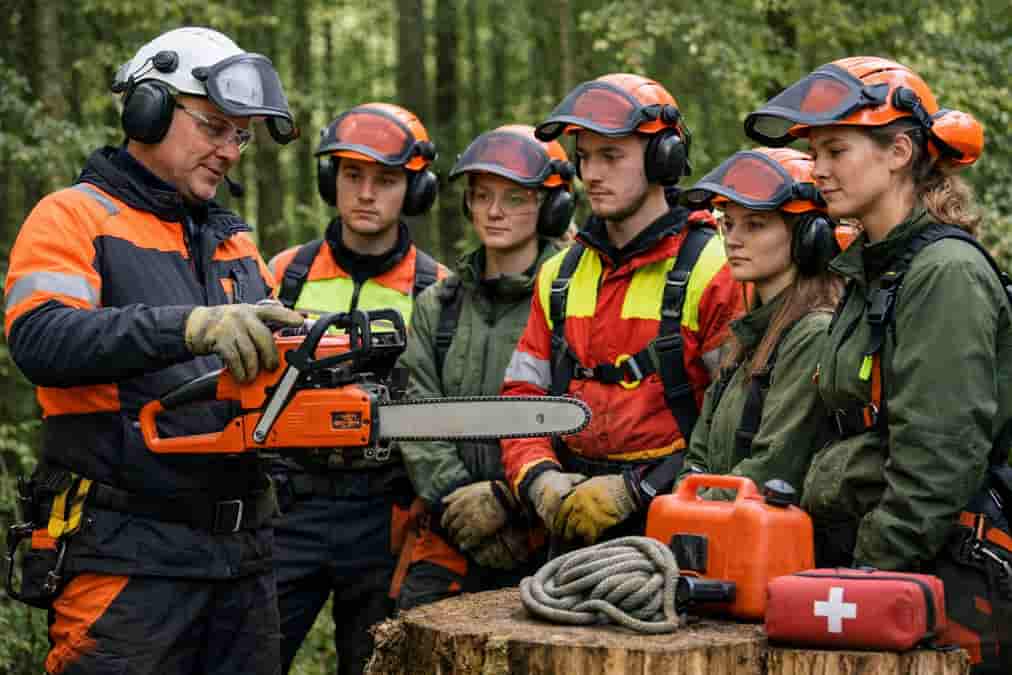
As National Apprenticeship Week gets underway from 9 to 15 February 2026, the Forestry Commission has confirmed a significant expansion of its apprenticeship offer, aimed squarely at strengthening the UK’s forestry workforce while supporting smaller employers often left behind by complex systems.
Timed deliberately to coincide with the national spotlight on apprenticeship skills and training, the announcement brings together two strands of policy thinking: opening up professional routes into forestry and easing the pressure on small and seasonal businesses that underpin much of the sector’s day-to-day work.
At the centre of the plans is recruitment for the next cohort of Development Woodland Officers, alongside a new pilot scheme designed to help smaller forestry employers access apprentices without the heavy administrative burden that has historically acted as a barrier.
Taken together, the programmes underline the role apprenticeships continue to play in delivering skilled, meaningful work while supporting wider environmental ambitions and long-term economic stability across rural and regional Britain.
Building skills for a growing sector
Forestry has increasingly moved into focus as the UK balances environmental targets with economic growth. Skilled woodland management, sustainable planting and long-term stewardship all rely on a pipeline of trained professionals — something the Forestry Commission has been working to address since the launch of its apprenticeship pathways in 2022.
David Bole, Head of Green Economy and Skills at the Forestry Commission, framed the latest intake as part of that longer-term approach.
He said forestry offers “meaningful, skilled work in the natural environment” and pointed to the Sector Skills Plan as evidence of ongoing government backing for workforce development. The intention, he noted, is simple but critical: ensuring the UK has the foresters it needs both now and in the decades ahead.
Since the Professional Forester Apprenticeship programme began, 50 apprentices have already started their careers within the Forestry Commission itself, with a further 49 entering the profession via other employers across the sector — a figure that illustrates both demand and momentum.
Graduate apprenticeships now open
Applications are now open for eight Development Woodland Officers to join the Professional Forester Apprenticeship programme, delivered in partnership with University of Cumbria.
The three-year programme is paid and deliberately broad in its eligibility. School leavers, graduates and those considering a career change are all encouraged to apply, reflecting a recognition that forestry attracts people at different stages of working life.
Successful apprentices will work towards a Professional Forester Apprenticeship, equivalent to Level 6, alongside a BSc (Hons) in Professional Forestry. On completion, they will also be eligible to apply for Chartered Forester status with the Institute of Chartered Foresters, a significant professional milestone.
For UK workers seeking long-term, skills-based careers connected to land, sustainability and environmental resilience, the pathway offers both structure and progression — two elements often cited as missing from traditional entry routes into the sector.
New support for small forestry businesses
Alongside graduate recruitment, a new pilot scheme aims to address a quieter but persistent issue: the difficulty small forestry employers face when trying to take on apprentices.
Under the scheme, non-profit organisation Supplytrain will manage the administrative elements of Level 3 Forest Craftsperson apprenticeships. That includes recruitment support, HR, payroll and college liaison — areas that can be disproportionately demanding for micro-businesses.
Employers will be responsible only for paying wages and providing on-the-job work. Mandatory training, including chainsaw operation, pesticide handling and forestry first aid, will be covered, with additional support for travel and accommodation so apprentices can attend college where needed.
Importantly, apprentices may also be shared across businesses. This flexibility means employers are not locked into a full two-year commitment, making participation more realistic for seasonal operations.
For workers, it widens access to hands-on training. For employers, it removes friction from a system that has often favoured larger organisations.
Why this matters for UK workers
National Apprenticeship Week often brings bold statements about opportunity. What stands out here is delivery. These schemes focus on real barriers — cost, administration, access — while offering clear outcomes for those entering or re-entering the workforce.
Forestry may not always dominate national headlines, but it supports thousands of livelihoods, particularly in rural communities. Programmes like these reinforce the message that skilled work, environmental responsibility and economic contribution are not competing ideas, but connected ones.
For The Workers Union, initiatives that expand access to paid training, reduce unnecessary complexity and create genuine career routes align closely with our focus on practical outcomes for working people across the UK.