Nearly 60,000 workplace injuries were officially reported across the UK last year, laying bare what safety experts now describe as a growing national workplace protection crisis affecting thousands of UK workers across construction, manufacturing, agriculture and industrial sectors.
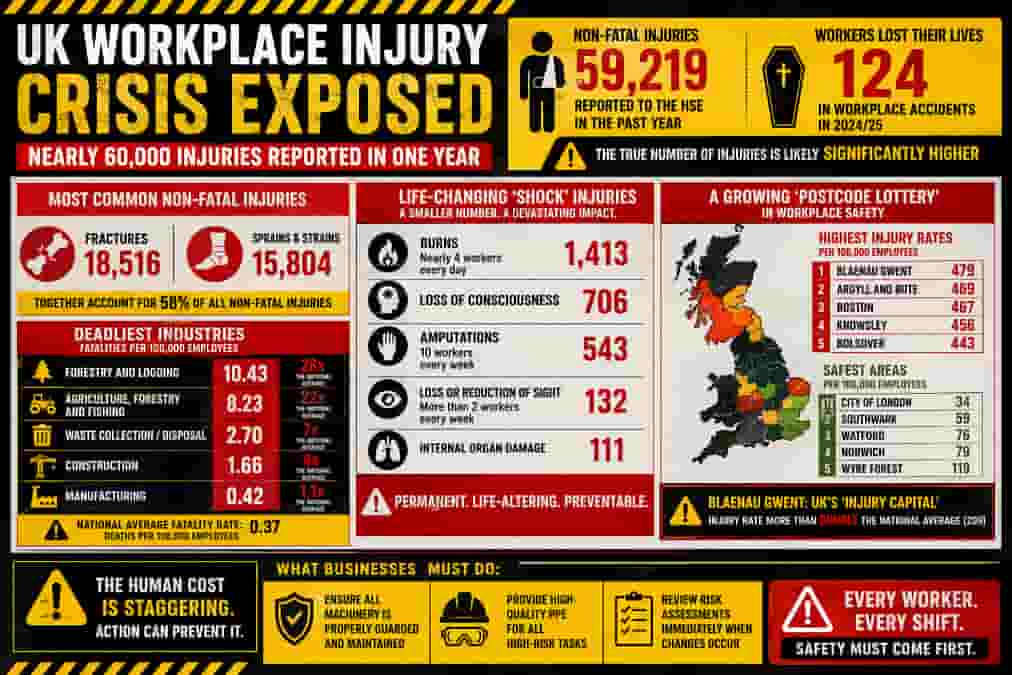
New analysis from workplace safety specialists Direct365 found that 59,219 non-fatal workplace injuries were reported to the Health and Safety Executive (HSE) during the past year alone. Yet experts warn the true scale is likely far worse, with survey data suggesting significant underreporting across multiple industries.
The figures also revealed that 124 workers lost their lives in workplace accidents during the 2024/25 reporting period, reigniting concerns about whether enough is being done to protect workers operating in high-risk environments across Britain.
The data paints a stark picture of the physical toll facing UK workers every single day.
Fractures accounted for 18,516 reported injuries, while sprains and strains reached 15,804 cases, together making up 58% of all non-fatal workplace injuries recorded last year.
But behind those already alarming numbers lies an even more disturbing category of what experts are calling “shock injuries” — life-changing incidents that permanently alter lives, careers and families.
The figures showed:
- 1,413 burns injuries
- 706 incidents involving loss of consciousness
- 543 amputations
- 132 cases involving loss or reduction of sight
- 111 incidents involving internal organ damage
In practical terms, that means nearly four workers suffered serious burns every day across the UK, while approximately ten workers each week experienced amputations severe enough to change their lives forever.
More than two workers every week also suffered permanent sight loss or significant visual impairment because of workplace accidents.
The most dangerous sectors revealed familiar patterns that continue to concern safety professionals.
Forestry and Logging recorded the highest fatality rate in Britain at 10.43 deaths per 100,000 employees, making workers in the sector more than 28 times more likely to die at work than the national average worker.
Agriculture, Forestry and Fishing followed closely behind with a fatality rate of 8.23 per 100,000 workers.
Waste Collection and Recycling Disposal recorded 2.70 deaths per 100,000 workers, while Construction — long associated with workplace danger — stood at 1.66.
Manufacturing reported a lower but still significant rate of 0.42 fatalities per 100,000 employees.
The findings are likely to intensify scrutiny around workplace protections in physically demanding industries already struggling with recruitment pressures, ageing workforces and ongoing economic uncertainty.
The research also uncovered major regional disparities, leading to warnings of an emerging “postcode lottery” for workplace safety across the UK.
Blaenau Gwent recorded the highest injury rate in Britain with 479 injuries per 100,000 employees. Argyll and Bute followed closely behind with 469, while Boston, Knowsley and Bolsover all recorded rates exceeding 440 injuries per 100,000 workers.
By comparison, the City of London recorded just 34 injuries per 100,000 employees — reflecting the lower physical risks associated with office-based employment and professional services.
Southwark, Watford, Norwich and Wyre Forest were also among the safest areas to work in Britain according to the study.
Karl Bantleman of Direct365 warned that the findings exposed a deeply uneven safety landscape across the country.
He said: “While a worker’s physical safety should never be determined by their postcode, the data reveals a worrying workplace safety lottery across the UK.
Bantleman also urged employers to review machinery safeguards, improve access to quality PPE and immediately reassess workplace risks whenever operational changes occur.
Responding to the findings, Jonathan Morgan, spokesperson for The Workers Union, said many UK workers continue to face unacceptable risks simply for doing their jobs.
Mr Morgan continued: “Every worker has the right to return home safely at the end of their shift. These figures are deeply concerning, particularly when we see permanent injuries such as amputations, burns and loss of sight continuing to occur across UK workplaces.
“Too often, workers feel pressure to continue operating in unsafe environments because they fear losing income or damaging their position at work. Safety procedures cannot become optional during busy periods or times of economic pressure.
“Employers must ensure risk assessments are meaningful, equipment is properly maintained, and workers are fully trained and protected. Prevention must always come before profit.”
The findings are expected to renew debate around workplace safety enforcement, employer responsibilities and whether enough inspections are taking place in Britain’s highest-risk industries.
For many UK workers, particularly those in physically demanding sectors, the statistics are more than numbers — they represent colleagues, families and lives permanently changed in a matter of seconds.