A shipping company has been fined more than £146,000 after a worker suffered life-changing injuries when he was struck by a reversing forklift truck at a busy Aberdeen facility.
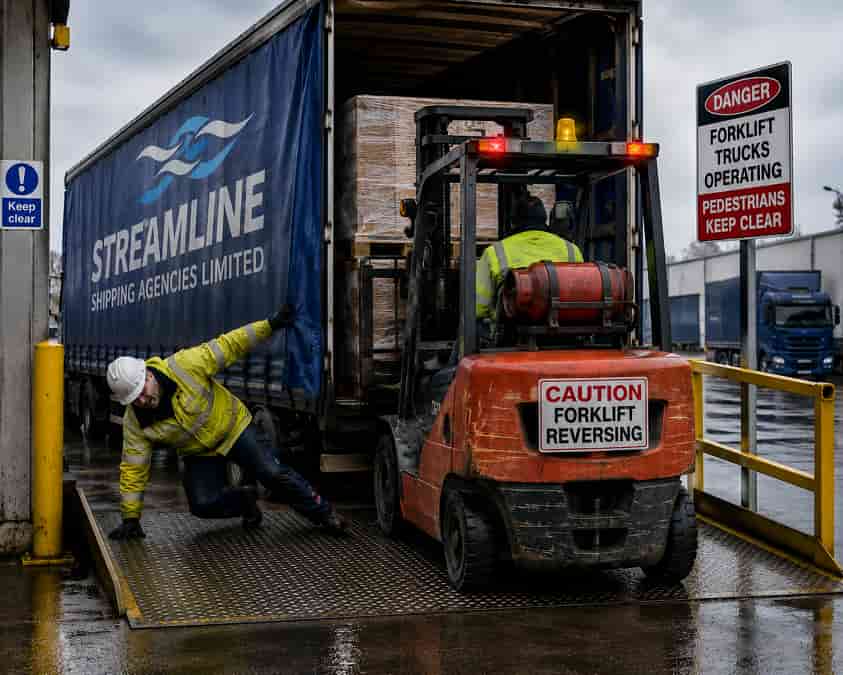
The incident occurred on 26 September 2024 at the premises of Streamline Shipping Agencies Limited. A 43-year-old employee was unclipping the curtain side of an articulated trailer when a reversing forklift truck struck his leg, causing him to fall to the ground.
The worker suffered multiple fractures to his right foot and lower leg, together with a serious degloving injury. Since the incident, he has undergone two operations and skin graft procedures and remains unable to return to work.
Forklift truck accident highlights importance of workplace traffic management
Following an investigation by the Health and Safety Executive (HSE), inspectors found that the company had failed to ensure the safe movement of vehicles and pedestrians within the workplace.
At Aberdeen Sheriff Court on 22 May 2026, Streamline Shipping Agencies Limited pleaded guilty to breaches of health and safety legislation. The company was fined £146,700 and ordered to pay a victim surcharge of £11,000.
HSE finds shortcomings in traffic management arrangements
According to the HSE investigation, the company had a traffic management plan in place. However, inspectors concluded that it lacked sufficient detail to safely manage loading and unloading activities, which routinely took place at the same time in shared operational areas.
Investigators determined it was reasonably foreseeable that a worker on foot could be struck by a moving vehicle when both the pedestrian and forklift operator were focused on separate tasks in close proximity.
The HSE subsequently served an improvement notice on the company.
She emphasised that employers have a legal duty to ensure pedestrians and vehicles can move safely around workplaces, particularly in busy loading and unloading environments.
Company responds following court proceedings
A spokesperson for Streamline Shipping Agencies Limited acknowledged the outcome of the court proceedings and expressed sympathy for the injured employee and his family.
The company stated that following the incident and subsequent HSE investigation, it reviewed and strengthened its traffic management procedures. The improvements were later accepted by the regulator as satisfactory.
The company added that it would not be making any further comment out of respect for those involved.
The Workers Union responds
Jonathan Morgan, spokesperson for The Workers Union, said:
“Every worker and member has the right to return home safely at the end of their shift. Incidents involving workplace vehicles remain one of the most significant risks across many industries, particularly in logistics, warehousing and transport environments.
“This case serves as a stark reminder that traffic management plans must be practical, detailed and actively enforced. Procedures on paper alone are not enough if they do not properly protect our workers on the ground.
“Our thoughts are with the injured worker and his family as they continue to deal with the lasting consequences of this incident.”
What UK workers should know
Forklift trucks are involved in hundreds of workplace incidents every year across the UK. Common risks include:
- Poor separation of pedestrians and vehicles
- Inadequate traffic management systems
- Restricted visibility
- Reversing vehicles operating in busy areas
- Insufficient supervision of loading and unloading activities
Cases such as this demonstrate why effective planning, supervision and workplace safety measures remain essential in preventing serious injuries.
From The Workers Union
The Aberdeen incident highlights the devastating consequences that can arise when vehicle and pedestrian movements are not effectively managed. While the financial penalty imposed on the company is significant, it cannot undo the impact on the injured worker, whose life has been permanently altered. For employers across the UK, the message from regulators remains clear: workplace transport risks must be properly assessed, controlled and continuously monitored to protect workers from harm.