
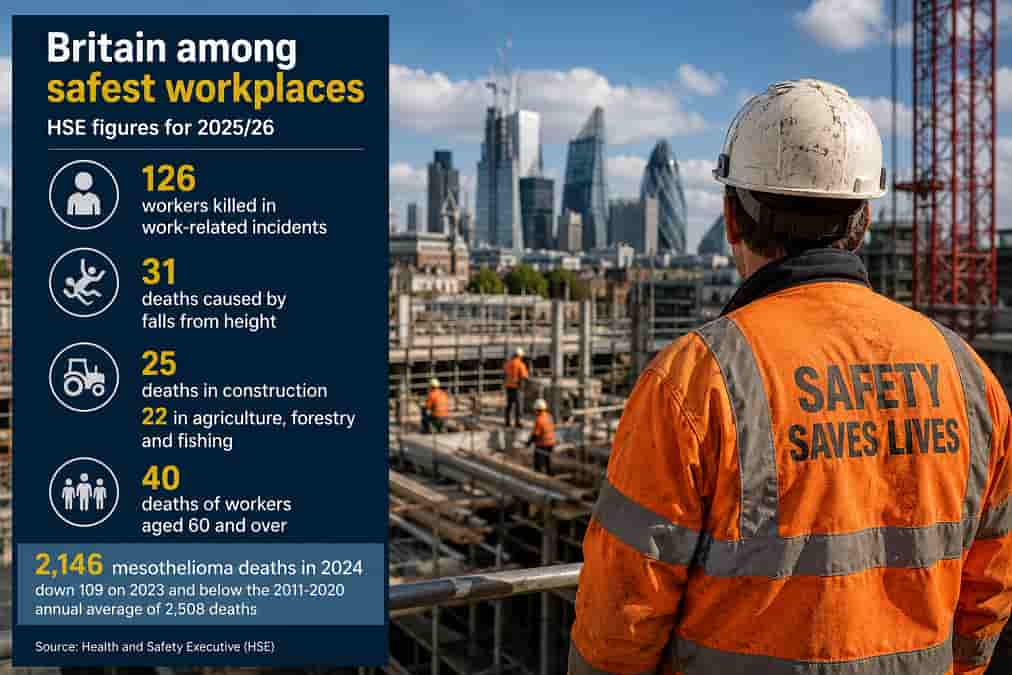
Great Britain remains one of the safest places in the world to work, but the latest figures still carry a stark message for UK workers: 126 people left for work in 2025/26 and did not come home.
The Health and Safety Executive confirmed that 126 workers were killed in work-related incidents in Great Britain during 2025/26. The figure is provisionally the lowest recorded in a single year when the pandemic-affected years are excluded, down from 217 fatalities in 2005/06 and 495 in 1981.
Construction recorded the highest number of deaths, with 25 fatalities, followed by agriculture, forestry and fishing with 22. Agriculture, forestry and fishing also had the highest fatal injury rate at 8.09 per 100,000 workers, followed by waste and recycling at 5.47. The all-industry average was 0.37.
Falls from height remained the leading cause of serious injury or death, accounting for 31 fatalities, around a quarter of all worker deaths. Workers aged 60 and over accounted for 40 deaths, around a third of the total, despite making up only 12 per cent of the workforce.
HSE’s new international comparison looked at Great Britain against 35 other countries. The report found most countries had higher work-related fatal injury rate ratios than Great Britain, with only the Netherlands estimated to be lower. Belgium, Denmark, Finland, Poland, Slovakia and Switzerland were assessed as similar to Great Britain.
The HSE cautioned that the international figures are model-based estimates and should not be used as a simple country ranking. Countries are compared against Great Britain individually, not directly against each other.
Alongside the fatal injury figures, HSE also confirmed 2,146 mesothelioma deaths in Great Britain in 2024, linked to past asbestos exposure. This was 109 fewer than in 2023 and lower than the 2011-2020 annual average of 2,508.
Jonathan Morgan, of The Workers Union, said:
“Great Britain’s safety record deserves recognition, but no worker death should ever be treated as acceptable or inevitable. These figures show progress, but they also show where attention is still urgently needed. Construction, agriculture, waste, working at height and asbestos exposure remain serious issues for working people. The priority must always be prevention, proper planning, clear communication, and making sure every worker feels able to raise a concern before harm occurs.”
For UK workers, the message is clear. Britain may compare strongly on the world stage, but safety is not a statistic. It is a daily responsibility, carried by employers, managers, supervisors and every workplace that depends on people doing difficult jobs in demanding conditions.