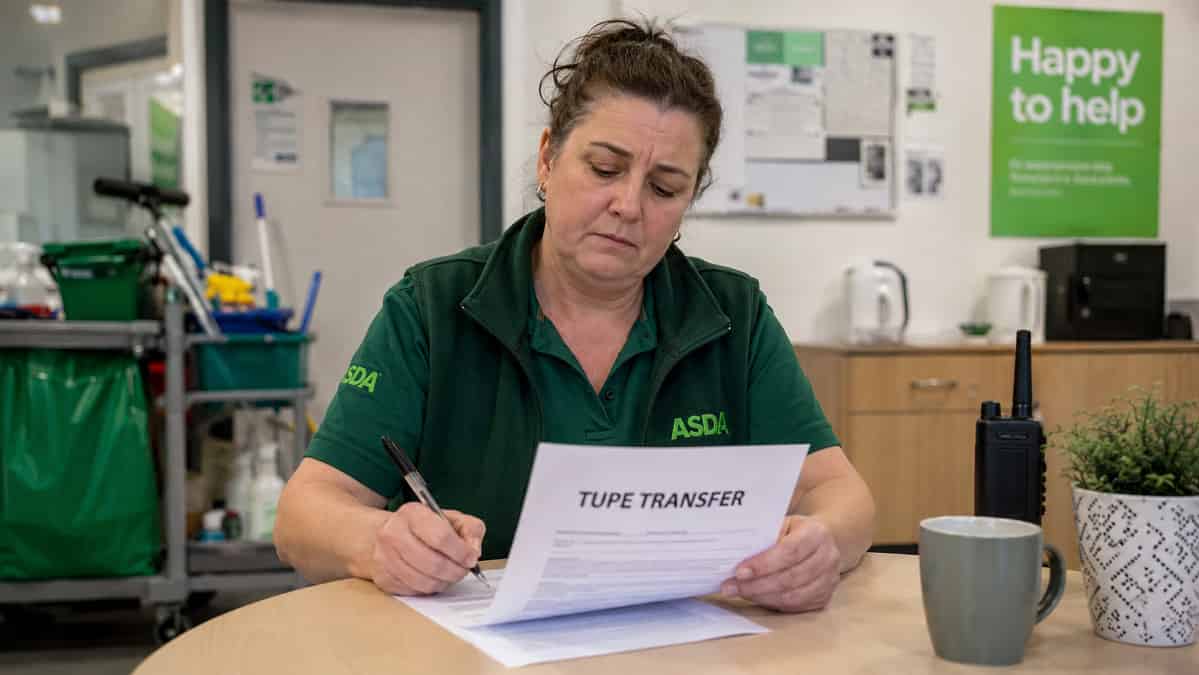
Around 3,500 Asda cleaning workers are facing a significant change to their employment after the supermarket announced plans to outsource cleaning services across its UK stores.
The affected employees are expected to move from Asda to one of two external cleaning companies. Bidvest will take responsibility for stores across northern England and Scotland, while NIC Services will operate the contract across southern England.
Asda says no redundancies are planned as part of the proposal. Workers were informed on Tuesday 11 August, with the supermarket aiming to complete the transition by 1 October 2026.
That assurance will provide some immediate relief. However, for thousands of workers, the announcement still raises important questions about their future employer, workplace benefits, working patterns and longer-term job security.
What will happen to Asda cleaning workers?
Asda expects the affected employees to transfer under the Transfer of Undertakings (Protection of Employment) Regulations, commonly known as TUPE.
Government guidance explains that when TUPE applies, an employee’s job will usually transfer to the incoming employer. Their contractual terms, holiday entitlement and continuous employment should also move with them. The transfer should not reset the worker’s original employment start date.
This means the proposal is not simply a change of uniform or management structure. Bidvest or NIC Services would become the legal employer of the affected cleaning staff.
Workers should receive clear written information explaining:
- which company will become their employer
- the proposed transfer date
- whether their workplace or reporting arrangements will change
- whether any working practices will be affected
- what will happen to benefits connected specifically to Asda
- whether the incoming contractor is proposing any measures after the transfer
According to official government guidance on TUPE transfers, outsourcing an in-house cleaning service is precisely the type of service provision change that is likely to be covered by the regulations.
What has Asda said about the change?
David Lepley, chief operating officer at Asda, said the company’s ambition was to deliver “the cleanest stores in retail”.
He said partnering with Bidvest and NIC Services would give the supermarket access to newer cleaning machinery and technology.
Customers are expected to see cleaner toilets, steam-cleaned trolleys and baskets, and increased use of robotic cleaning equipment. The company has presented the proposal as an investment intended to improve cleanliness and the customer experience.
Yet the central question for workers is not whether the stores will have newer machines. It is whether the people who have kept those stores clean will continue to receive fair treatment, reliable hours and proper recognition for the work they perform.
The Workers Union calls for clarity and long-term safeguards
Jonathan Morgan spokesperson for The Workers Union said:
“The announcement that no redundancies are planned is welcome, but it must be followed by meaningful safeguards for every affected worker. Approximately 3,500 people now face the uncertainty of leaving a familiar employer and transferring to an external company.
“Asda, Bidvest and NIC Services should provide clear information about pay, contracted hours, workplace benefits, holiday arrangements, pensions, location requirements and management structures before the proposed transfer takes place.
“Cleaning workers perform an essential role in maintaining safe, hygienic and welcoming stores. The introduction of robotic equipment must support those workers rather than create uncertainty about their future hours or job security.
“The Workers Union believes every affected employee should know their rights at work and keep copies of their contract, recent payslips, holiday records and written communications concerning the transfer. No worker should feel pressured into accepting unexplained changes.”
Does TUPE guarantee that nothing can change?
TUPE provides important employment protection, but workers should not assume it guarantees that every arrangement will remain unchanged indefinitely.
The incoming employer generally cannot alter contractual terms when the sole or principal reason for the change is the transfer itself. Certain changes may, however, be permitted where there is a valid economic, technical or organisational reason involving changes to the workforce or workplace and the employee agrees.
The government’s guidance on transferred employment contracts confirms that existing terms and conditions, holiday entitlement and continuous service normally transfer to the new employer.
Workers who object to transferring should also exercise caution. Refusing to move to the incoming employer will usually be treated in a similar way to resignation, and the employee would not normally receive redundancy pay. Anyone considering that option should seek individual advice before making a decision.
Previous outsourcing increases worker concerns
The cleaning announcement follows Asda’s earlier decision to outsource store security operations to Mitie. That contract involved more than 2,000 workers transferring under TUPE, according to Mitie’s announcement about the Asda security contract.
The earlier move matters because it demonstrates that outsourcing at Asda is not an isolated operational decision. It forms part of a wider shift towards external providers delivering significant store services.
For the 3,500 cleaning workers now affected, the coming weeks must therefore be about more than completing an administrative transfer by 1 October. Workers need direct answers, properly recorded commitments and sufficient time to understand what the change means for their individual circumstances.
New cleaning technology may help Asda improve its stores, but the success of this investment will ultimately depend on the people expected to use it. Those UK workers deserve certainty, respect and employment standards that remain dependable after the contractor’s name changes.