A construction company has been fined after a bricklayer suffered life-changing injuries when he fell more than 2.6 metres through an unguarded gap while carrying out work at a residential property in Leamington Spa.
The incident happened on 16 July 2024 at a property on Binswood Avenue, where 65-year-old bricklayer Nicholas Crow, an employee of Sibbasbridge Limited, was helping to replace external steps.
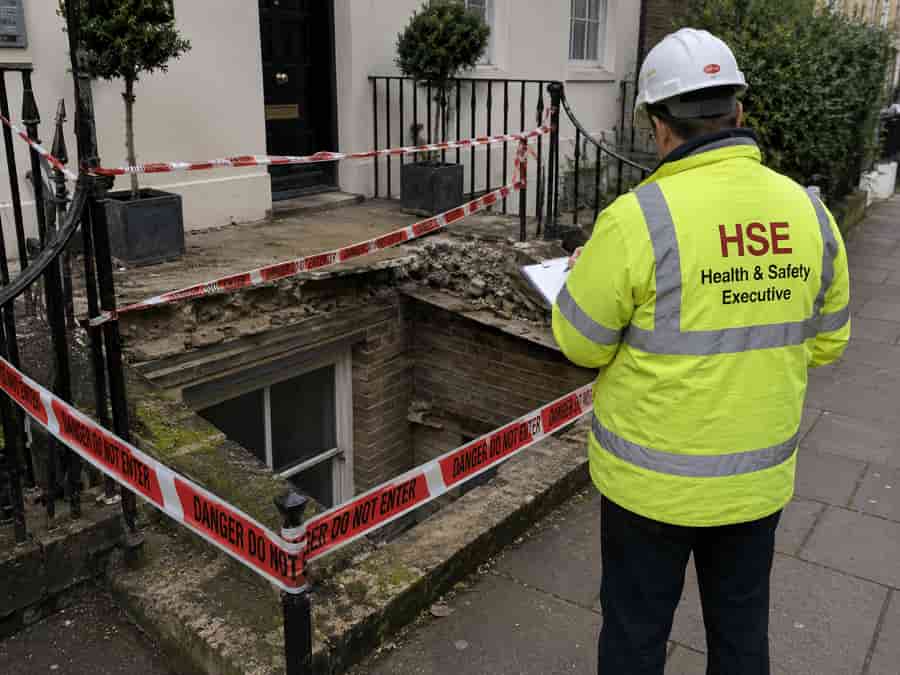
The previous day, railings had been removed to allow the old steps to be dismantled, leaving an unguarded opening above a basement lightwell. While assisting with the installation of the new steps, Mr Crow fell through the gap and landed on the floor of the basement lightwell approximately 2.6 metres below.
The devastating fall resulted in severe head injuries and a stroke. Mr Crow has since been left with significant long-term disabilities, including difficulties writing and holding objects, impaired mobility requiring occasional use of a wheelchair, and ongoing speech and memory problems.
Construction company fined after HSE finds serious work at height failures
The Health and Safety Executive (HSE) investigated the incident and found that Sibbasbridge Limited had failed to implement suitable and sufficient measures to prevent a fall from height. The company also failed to prepare a task-specific risk assessment or method statement before the work commenced.
Investigators further found that no scaffolding, edge protection or other suitable fall prevention measures had been installed before employees began replacing the steps.
Working at height remains one of the leading causes of fatal and serious workplace injuries across the UK construction industry. HSE guidance makes it clear that employers must properly plan all work at height, assess the specific risks involved and implement appropriate physical safeguards, including scaffolding, guardrails, coverings or other suitable collective protection measures wherever there is a risk of falling.
In a deeply moving victim personal statement, Mr Crow’s wife, Sarah, described the lasting impact the incident has had on their family.
She said her husband had been “quiet, reliable, and the heart of our very close, extended family” and that the injuries had robbed him of the life he had worked nearly 50 years to build.
She added that both she and her husband now live with the emotional consequences of the incident every day, describing it as a grief that continues to affect the entire family.
Jonathan Morgan, of The Workers Union, said:
“Every worker and TWU member has the right to expect that they will return home safely at the end of the working day. Falls from height remain one of the most foreseeable and preventable causes of serious injury and death in the construction industry, yet incidents like this continue to occur because basic safety measures are overlooked.
“This was not a complex engineering challenge. Simple precautions, including a suitable task-specific risk assessment, an appropriate method statement and effective edge protection, could have prevented a worker from falling through an exposed opening.
“Our thoughts are with Nicholas Crow and his family, whose lives have been permanently changed by this incident. Employers must recognise that health and safety planning is not paperwork for its own sake. It is about protecting lives. Every construction project, regardless of its size, must be properly planned before work begins.”
A reminder for employers
The HSE continues to remind employers that they have a legal duty to:
- Carry out suitable and sufficient risk assessments before work starts.
- Prepare task-specific method statements where appropriate.
- Properly plan all work at height.
- Install suitable collective fall prevention measures such as scaffolding, guardrails or edge protection.
- Ensure workers are adequately supervised and provided with safe systems of work.
Construction remains one of the UK’s highest-risk industries, with falls from height consistently accounting for a significant proportion of workplace fatalities and life-changing injuries. Employers who fail to manage these risks not only place workers in danger but also face substantial legal and financial consequences.