A Lancashire engineering company has been fined £48,000 after a worker lost part of his thumb in a devastating workplace accident — just days after a near-identical incident had already occurred at the same factory.
Todd Marshall, a welder and fabricator employed by Fitzpatrick Fabrications Ltd in Nelson, suffered a serious crush injury to his right hand when a heavy stainless-steel structure slipped during a manual-handling operation.
The accident has left him struggling with everyday activities and ended his hopes of progressing further in amateur boxing, a sport he described as his whole life.
But perhaps the most troubling finding from the Health and Safety Executive (HSE) investigation was that the company had already experienced a remarkably similar incident only days earlier.
The regulator concluded that the accident was entirely preventable.
For workers across Britain’s manufacturing, engineering, warehousing and construction industries, the prosecution raises a fundamental question: how many warnings should an employer need before making a dangerous task safe?
A 133kg structure slipped onto worker’s hand
The accident happened on 24 October 2024 at Fitzpatrick Fabrications’ factory at Malvern Mill in Nelson, Lancashire.
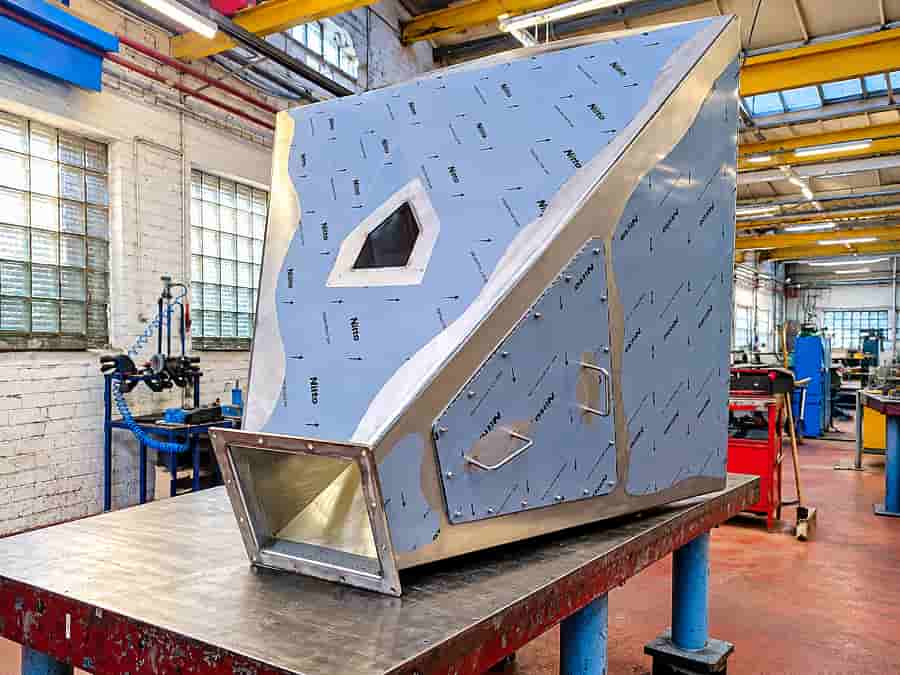
Mr Marshall was fabricating a large stainless-steel hopper consisting of five separate components that needed welding together.
As each section was completed, the structure had to be lifted and repositioned to allow further welding.
According to the official HSE prosecution report, Mr Marshall was carrying out the operation alone.
He was holding the larger side of the 133kg hopper in the air while the smaller side rested on a desk.
The hopper slipped across the smooth surface and fell onto his hand.
The impact caused a severe crush injury and the partial loss of his right thumb.
What should have been another ordinary working day resulted in permanent consequences.
Near-identical accident had happened days earlier
The HSE investigation revealed that Fitzpatrick Fabrications had failed to conduct a risk assessment for the manual-handling operation.
There was also no safe system of work explaining how the task should be performed.
Consequently, employees had not received clear instructions about how to handle and reposition the heavy structure safely.
But investigators uncovered something even more concerning.
A near-identical incident had taken place in the days immediately preceding Mr Marshall’s accident.
That earlier event should have provided an opportunity to examine the task, identify the dangers and introduce effective precautions.
Instead, another worker suffered a serious and life-changing injury.
The case highlights why employers must treat accidents and near misses as warnings requiring action.
A dangerous event that causes no injury on one occasion may have devastating consequences when the same circumstances arise again.
Boxing dreams ended by workplace injury
The consequences for Mr Marshall extend far beyond the loss of part of his thumb.
In his statement released by HSE, he described how tasks he previously performed without thinking have become difficult.
He now struggles with everyday activities such as fastening buttons, using zips and picking up small objects.
Before the accident, he was a keen amateur boxer.
Boxing was much more than a casual hobby. It was something he had invested considerable time, dedication and ambition in.
The injury has taken away his opportunity to discover how far he might have progressed in the sport.
His experience demonstrates that workplace accidents do not end when an injured employee leaves hospital.
The effects can continue through rehabilitation, family life, financial circumstances, hobbies and future career opportunities.
A worker may eventually return to employment while still living with the consequences of an injury every day.
Company fined £48,000
Fitzpatrick Fabrications Ltd pleaded guilty to breaching Regulation 4(1) of the Manual Handling Operations Regulations 1992.
At Warrington Magistrates’ Court on 6 October 2026, the company was fined £48,000 and ordered to pay £10,089 in costs.
HSE inspector Derek McLauchlan described the accident as wholly preventable and emphasised its profound, long-lasting effect on Mr Marshall’s life.
He also highlighted the particularly troubling fact that an almost identical incident had occurred only days before.
The regulator’s findings underline the responsibility employers have to assess potentially dangerous manual-handling operations and establish appropriate precautions before workers are exposed to unnecessary risks.
Manual handling is not just about lifting boxes
When people hear the phrase manual handling, they often imagine somebody lifting a heavy cardboard box.
But the risks are considerably broader.
Manual handling can involve lifting, lowering, pushing, pulling, carrying, supporting or repositioning objects.
In engineering and manufacturing environments, workers may be required to handle large metal components, machinery parts, fabricated structures and awkwardly shaped materials.
Some loads are particularly dangerous because of their size, balance, shape or instability.
A heavy object does not necessarily need to be lifted completely off the ground to cause a serious injury.
In Mr Marshall’s case, the danger arose while repositioning a large metal structure during fabrication.
The HSE’s manual-handling guidance explains that employers must avoid hazardous manual handling where reasonably practicable, assess unavoidable risks and reduce the remaining danger.
This may involve mechanical lifting equipment, changing the working method, redesigning the task or introducing additional safeguards.
Why risk assessments matter
Risk assessments are sometimes regarded as paperwork rather than a practical workplace safeguard.
This prosecution demonstrates why that attitude can be dangerous.
A suitable assessment should consider the weight and dimensions of the load, its stability, the working surface, the equipment available and the safest method of carrying out the operation.
It should also consider whether one person can perform the task safely.
For hazardous handling operations, employers may need to provide suitable mechanical assistance rather than relying on physical strength or experience.
The HSE provides a Manual Handling Assessment Charts tool, designed to help identify potentially high-risk lifting, carrying and team-handling activities.
However, the tool does not replace the need for an assessment appropriate to the actual working conditions.
As The Workers Union previously highlighted in its article on rising manual-handling injuries across UK workplaces, physically demanding work can expose employees to serious harm when appropriate precautions are missing.
The risks are not confined to heavy industry.
They affect warehouse employees, delivery drivers, construction workers, retail staff, healthcare workers and many others.
Previous warnings must lead to action
One of the most important lessons from this prosecution concerns the treatment of previous incidents.
When something almost goes wrong, the absence of injury does not mean the workplace is safe.
It may simply mean that nobody was hurt on that particular occasion.
Employers should investigate significant near misses, examine why they happened and introduce appropriate measures to prevent recurrence.
That principle also featured in our earlier report, 1.2-tonne crate falls from forklift leaving worker seriously injured.
Although the circumstances differed, both incidents illustrate the serious consequences that can follow when unusual or dangerous handling operations are not properly planned.
In Mr Marshall’s case, the earlier near-identical incident makes the failure to establish a safe method particularly troubling.
An accident should never have to happen twice before somebody takes notice.
What should workers do when a task appears unsafe?
Workers should be able to raise genuine safety concerns before carrying out tasks that could place them or colleagues at risk.
Warning signs might include an unstable load, insufficient lifting equipment, an awkward handling position or uncertainty about how a task should be completed safely.
Where appropriate, workers should ask for clarification about the risk assessment, the approved working method and whether additional equipment or assistance is necessary.
If an incident or near miss has already occurred, that information should be reported and properly investigated.
Employers have legal responsibilities to manage workplace risks, and employees should not be expected to improvise potentially dangerous methods simply to complete a job.
The HSE’s guidance on reducing manual-handling injuries provides practical examples of how equipment and changes to working methods can make tasks safer.
The true cost of a preventable accident
A £48,000 fine is a substantial financial penalty.
But the human cost of this incident cannot be measured simply by the amount imposed by the court.
Todd Marshall has lost part of his thumb.
Everyday activities have become more difficult.
A sport he loved, and in which he hoped to progress, is no longer part of his future in the way it once was.
And all of this followed an accident that the safety regulator concluded could have been prevented.
For employers, the lesson is clear: assess dangerous tasks, provide safe working methods and respond properly when something goes wrong.
For workers, the case reinforces the importance of speaking up when a task appears unsafe and ensuring that previous incidents are not ignored.
The most disturbing aspect of this prosecution is not simply that a worker suffered a life-changing injury. It is that an almost identical incident had already provided a warning just days earlier.
That warning should have been enough.