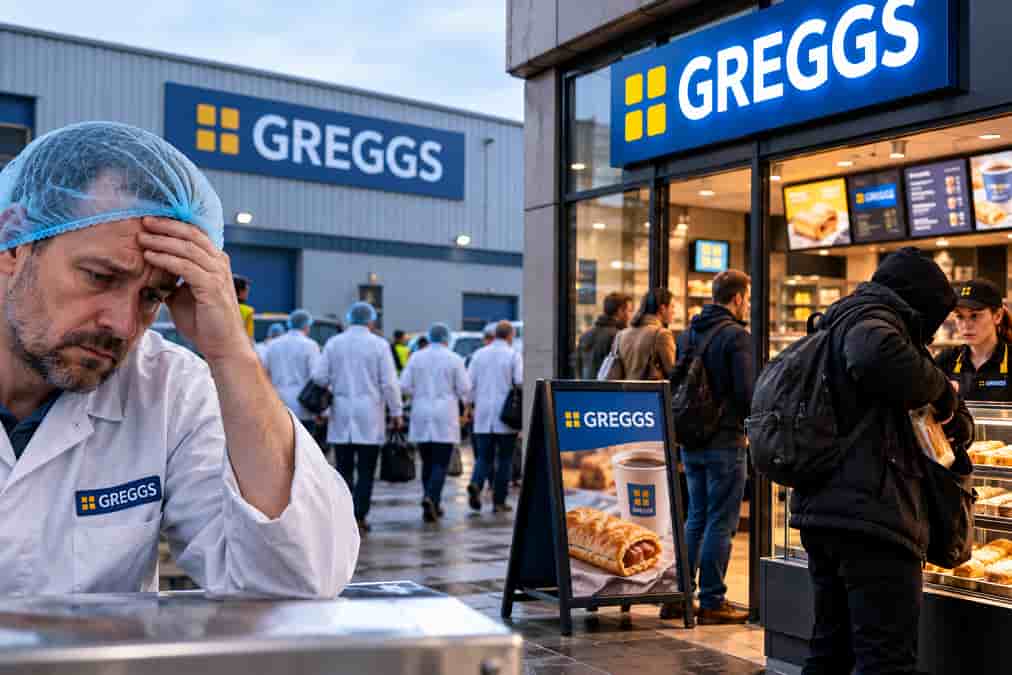
From builders grabbing a large sausage roll breakfast before heading onto site and office staff picking up a steak bake lunch between meetings, to shoppers, delivery drivers and healthcare workers needing something quick on the move, Greggs has become part of the everyday working landscape of Britain.
For working people, the attraction has long been straightforward: familiar food, readily available and somewhere to grab a quick bite to alleviate the hunger pangs during a busy working day. Greggs itself describes accessibility, value and convenience as central to its business, with its expanding network designed to reach customers wherever they happen to be.
But behind the sausage rolls, sandwiches and packed high-street shops, Greggs workers are facing pressures of their own.
Around 740 manufacturing roles are now at risk under proposals to reorganise the company’s production network and close four manufacturing sites.
At the same time, workers in Britain’s retail sector continue to confront shoplifting, abuse and threatening behaviour.
It presents a striking picture of modern retail Britain: customers continue coming through the doors, sales are rising and the business is expanding, yet hundreds of workers face uncertainty over whether their jobs will survive.
Four Greggs manufacturing sites could close
Greggs is proposing the closure of manufacturing operations at Enfield, North Lakes near Penrith, Pettigrews in Kelso and Seaham, alongside further changes elsewhere in its manufacturing network.
Manufacturing at Treforest would also end, although the site would continue operating as a distribution centre. The range of products produced at Clydesmill and Manchester would be reduced, while production of tinned bread at Gosforth would end.
The proposals would potentially result in around 740 roles becoming redundant over approximately two and a half years.
Crucially, these are currently proposals.
Greggs says consultation with affected workers is beginning and no final decisions have been made. Its official manufacturing announcement states that feedback received during consultation will be considered before final decisions are reached.
For workers hearing the words “at risk”, understanding that distinction is important.
Our redundancy rights guide explains consultation, selection, notice, redundancy payments and alternative employment in more detail for our members and non members.
The difficult contradiction: Greggs is growing
What makes the announcement particularly striking is that Greggs is not describing a business in retreat.
Its shop estate has expanded from 2,181 locations in 2021 to 2,796, while the company now employs approximately 33,000 people. Greggs says it has invested more than £300 million in manufacturing and logistics since the beginning of 2024 and is building infrastructure capable of supporting at least 3,500 shops.
The company’s latest corporate update describes Greggs as a strong and growing business.
So why are hundreds of jobs at risk?
The answer given by the company concerns restructuring rather than disappearing demand.
Greggs wants to consolidate manufacturing into fewer locations, move some production between sites and source a small number of products from specialist suppliers. The stated objective is a manufacturing operation that is more streamlined and efficient.
That may explain the commercial reasoning.
For the workers potentially losing their livelihoods, however, the calculation looks very different.
Greggs has become part of the working day
The scale of the business partly explains why this story resonates beyond the factory gates.
Greggs has increasingly positioned itself where working people and commuters actually are: high streets, retail parks, transport hubs and other busy locations.
Earlier this year, for example, the company opened another smaller-format shop at London Bridge station, saying the location would cater to commuters and travellers needing food on the move.
The expansion created new jobs.
That illustrates the unusual employment picture now emerging inside the same company: jobs can be created at one end of a growing business while disappearing at another.
This comes during an already challenging employment market. We recently reported how UK job vacancies fell for the 34th consecutive month, making substantial redundancy announcements particularly important for workers who may need to find alternative employment.
Shoplifting creates another pressure for retail workers
There is another side to Britain’s retail story.
Shoplifting and anti-social behaviour are not simply problems involving lost stock. They can become workplace safety issues for the person standing behind the counter.
The Government’s latest retail crime guidance shows the scale of the wider problem.
There were around 590,000 incidents of violence and abuse against retail workers during 2024-25.
Although that was lower than the previous year, the figure still represents roughly 1,600 incidents every day across the retail industry.
For workers, that means the human cost of retail crime can extend far beyond the value of whatever has been taken.
It can mean intimidation, threats and physical violence.
Stronger protection for shop workers
The law is also changing in response.
The Crime and Policing Act 2026 introduces a standalone offence of assaulting a retail worker, carrying a maximum penalty of six months’ imprisonment and/or an unlimited fine.
The legislation also removes the previous treatment of shop theft involving goods valued at £200 or less, meaning lower-value theft should no longer be perceived as somehow less worthy of enforcement.
The Government’s official retail crime factsheet explains the changes and the reasons behind them.
For people working behind Britain’s shop counters, these protections matter.
Nobody should regard threats, abuse or violence as simply part of serving the public.
Workers experiencing concerns around safety, working conditions, hours or restructuring can also use our dedicated support information for shop and retail workers.
But did shoplifting cause the Greggs redundancies?
This distinction is important.
There is no evidence that shoplifting caused the proposed loss of around 740 Greggs manufacturing roles. Greggs has not made that connection.
The company’s stated reasons concern manufacturing efficiency, consolidation, resilience and creating capacity for future growth.
It would therefore be wrong to suggest that theft from Greggs shops is responsible for factories potentially closing.
Nevertheless, the two developments demonstrate different pressures running through the same wider retail environment.
At one end, shop workers can face theft, abuse and difficult customer-facing situations.
At the other, manufacturing workers can find their jobs threatened by consolidation and the pursuit of greater operational efficiency.
And between the two sits a company that continues to expand.
What should workers facing redundancy expect?
Being told that your job is “at risk” is not the same as being told that you have been made redundant.
Consultation matters.
Affected workers should seek clear information about why their workplace or role is affected, what alternatives have been considered, how decisions will be made and whether suitable alternative employment exists.
Greggs continues to employ around 33,000 people across Britain and its retail estate remains unaffected by the proposed manufacturing changes.
That does not mean a vacancy somewhere else within the company will automatically constitute suitable alternative employment for an experienced manufacturing worker.
Location, pay, hours, skills, responsibilities and contractual arrangements can all matter.
Our UK redundancy rights hub provides further practical information for workers trying to understand what happens during a redundancy process.
At what cost?
There is something particularly uncomfortable about redundancies when the company proposing them is simultaneously expanding.
Investment, productivity and efficiency are important to successful businesses.
But those words can sound very different depending on which side of the factory gate somebody is standing.
For management, efficiency can mean streamlined manufacturing, lower operating costs and infrastructure capable of supporting thousands more shops.
For a worker in Penrith, Kelso, Seaham or Enfield, efficiency could ultimately mean losing a livelihood.
The Workers Union believes working people should remain at the centre of conversations about how successful businesses change.
Greggs has become a mainstay of everyday working Britain precisely because millions of people walk through its doors.
Behind every counter, production line, delivery and distribution network are workers who have helped create that success.
The company is growing.
Customers are still buying.
New shops are opening.
Yet around 740 manufacturing roles could disappear.
The consultation process now needs to establish whether that human cost can be reduced and whether realistic alternatives exist for the people whose working lives have suddenly become uncertain.
Because behind every corporate saving is something that cannot be expressed quite so neatly on a balance sheet: someone’s job.