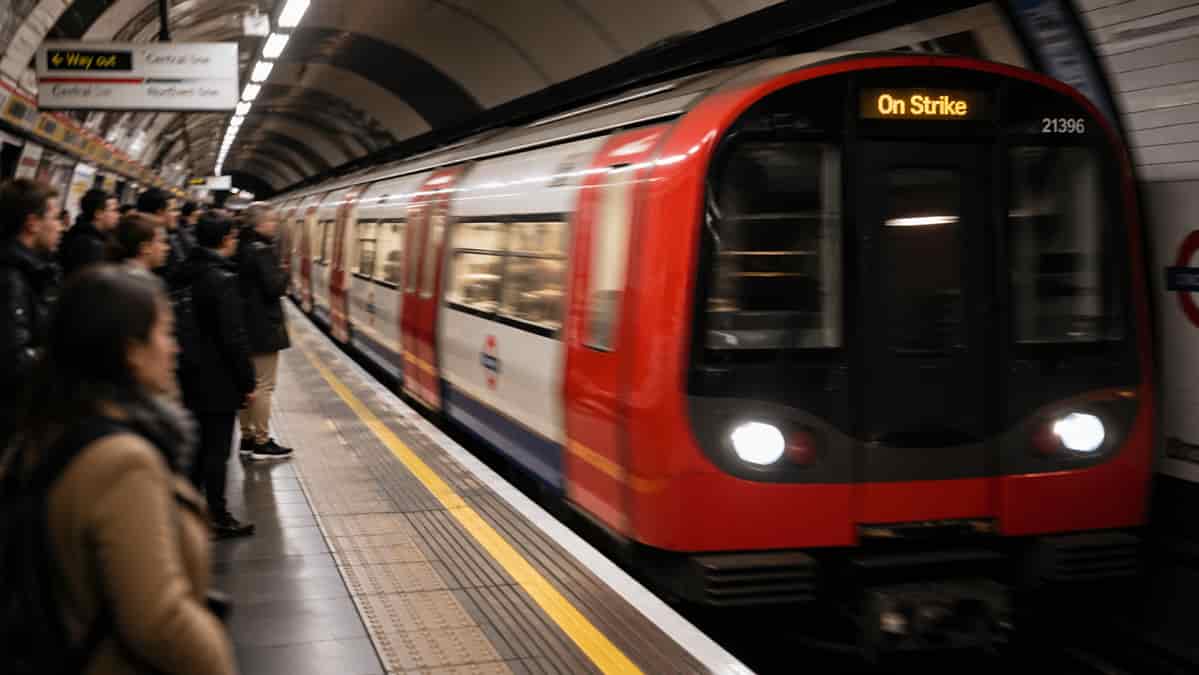
A fresh wave of disruption has swept across the capital, as a strike by drivers on the London Underground brought large parts of the network to a standstill, leaving thousands of workers scrambling to get to their jobs.
The 24-hour walkout began at midday on Tuesday, with further action scheduled to start again at midday on Thursday. The dispute centres on claims that Transport for London (TfL) is pushing through a new four-day working week without sufficient agreement, raising concerns among staff about working conditions and long-term impacts.
Widespread disruption across key lines
For many workers relying on the Tube, the disruption has been immediate and severe. Entire lines have been suspended, while others are only partially running with significant delays.
Among the worst affected:
- Circle line: fully suspended until midday
- Waterloo & City line: no service at all
Partial suspensions have hit key commuter routes:
- Bakerloo line: no service between Harrow & Wealdstone and Queen’s Park
- Central line: no service between Liverpool Street and White City
- Hammersmith & City line: no service between Liverpool Street and Barking
- Metropolitan line: no service between Baker Street and Aldgate
- Piccadilly line: major sections closed, including routes to Heathrow
Meanwhile, major delays have been reported across the District, Jubilee and Northern lines, with only minor delays on the Victoria line.
For workers travelling into central London, particularly those on early or shift-based roles, the timing has proved especially challenging. Many have been forced to seek alternative routes, absorb additional costs, or face lateness through no fault of their own.
Real impact on UK workers
This is not just a transport story—it is a workplace issue affecting productivity, income and wellbeing.
Across London, workers in sectors such as healthcare, retail, construction and hospitality have reported:
- Longer commute times adding hours to already demanding shifts
- Increased travel costs due to reliance on taxis or multiple transport modes
- Heightened stress from uncertainty and delays
- Risk of disciplinary action for lateness despite circumstances beyond their control
For those on fixed wages, even a single disrupted shift can have a knock-on effect financially. For hourly-paid staff, missed time can directly reduce earnings.
The Workers Union has consistently highlighted how external disruptions—whether transport, fuel costs or infrastructure issues—can disproportionately affect working people who have limited flexibility in how and when they travel.
What workers should do during disruption
With further strike action planned, preparation is key. Workers are advised to:
- Check live travel updates before leaving home
- Allow significantly more travel time where possible
- Keep evidence of delays (screenshots, travel alerts) if lateness becomes an issue
- Communicate with employers early to explain unavoidable disruption
Employers are also being urged to take a measured and reasonable approach, recognising that these disruptions are outside of a worker’s control.
A broader issue beyond the strike
While the immediate cause is industrial action, the situation reflects a wider pressure point within the UK’s transport infrastructure.
Rising operational costs, staffing pressures and changing working patterns are all feeding into disputes and service instability. For workers, the consequences are felt not in policy discussions, but in missed trains, delayed shifts and increased financial strain.
The Workers Union perspective
At The Workers Union, the focus remains firmly on ensuring that UK workers are supported through situations like this—where external pressures collide with workplace expectations. That being said, we have a no-strike policy here. Some disruption may be unavoidable, but the impact on workers should not be ignored.
As further strike action looms, the coming days will test both the resilience of London’s transport network and the flexibility of employers across the capital.
For many workers, the question is simple: how do you get to work when the system you rely on stops working?